
Chhath Puja mantras for the evening and dawn arghya, with meaning
Tirth editorial · 12 Jan 2026 · 5 min read
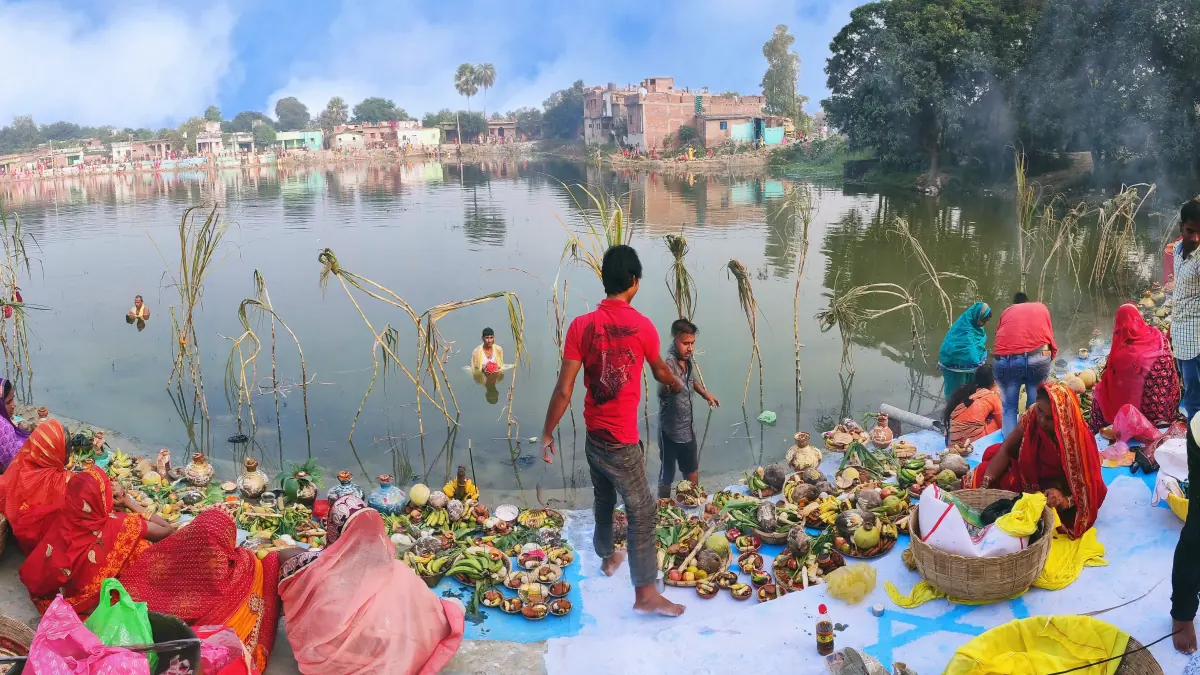
At Chhath, arghya (an offering of water) goes to the setting Sun on day three and to the rising Sun at dawn on day four. The Chhath Puja mantra said as the water falls is the verse “Om ehi Surya sahasransho”, which calls the Sun near and asks him to have compassion and accept the offering.
The verse runs to two lines, and one Chhath guide sets three short name mantras for Surya just before it. Of the short mantras here, only the eight-syllable mantra of the Surya Upanishad has a named source. Each appears in Devanagari, in Roman letters and in plain English, and the festival itself, day by day, is in Chhath Puja, the four days.
In 2026 the evening arghya falls on Sunday, 15 November and the dawn arghya on Monday, 16 November, and the Chhath Puja page of the Tirth Spiritual Calendar has sunset and sunrise times for your city.
Ehi Surya sahasransho: the arghya verse in full
ॐ एहि सूर्य सहस्रांशो तेजोराशे जगत्पते।
अनुकम्पय मां भक्त्या गृहाणार्घ्यं दिवाकर॥
oṃ ehi sūrya sahasrāṃśo tejorāśe jagatpate |
anukampaya māṃ bhaktyā gṛhāṇārghyaṃ divākara ||
Plain meaning (Tirth’s rendering): Om. Come, O Sun, thousand-rayed one, mass of splendour, lord of the world. Have compassion on me, and accept this water offering, given with devotion, O Divakara, maker of the day.
Hindi puja guides and newspaper columns on Surya arghya print this same verse. None of the sources checked for this page names the scripture it comes from. So on this page it is simply the traditional arghya verse, with no book and chapter put to it. Spellings differ slightly between printings (some write सहस्त्रांशो for सहस्रांशो, or ऐहि for एहि), and the sense of the line stays the same.
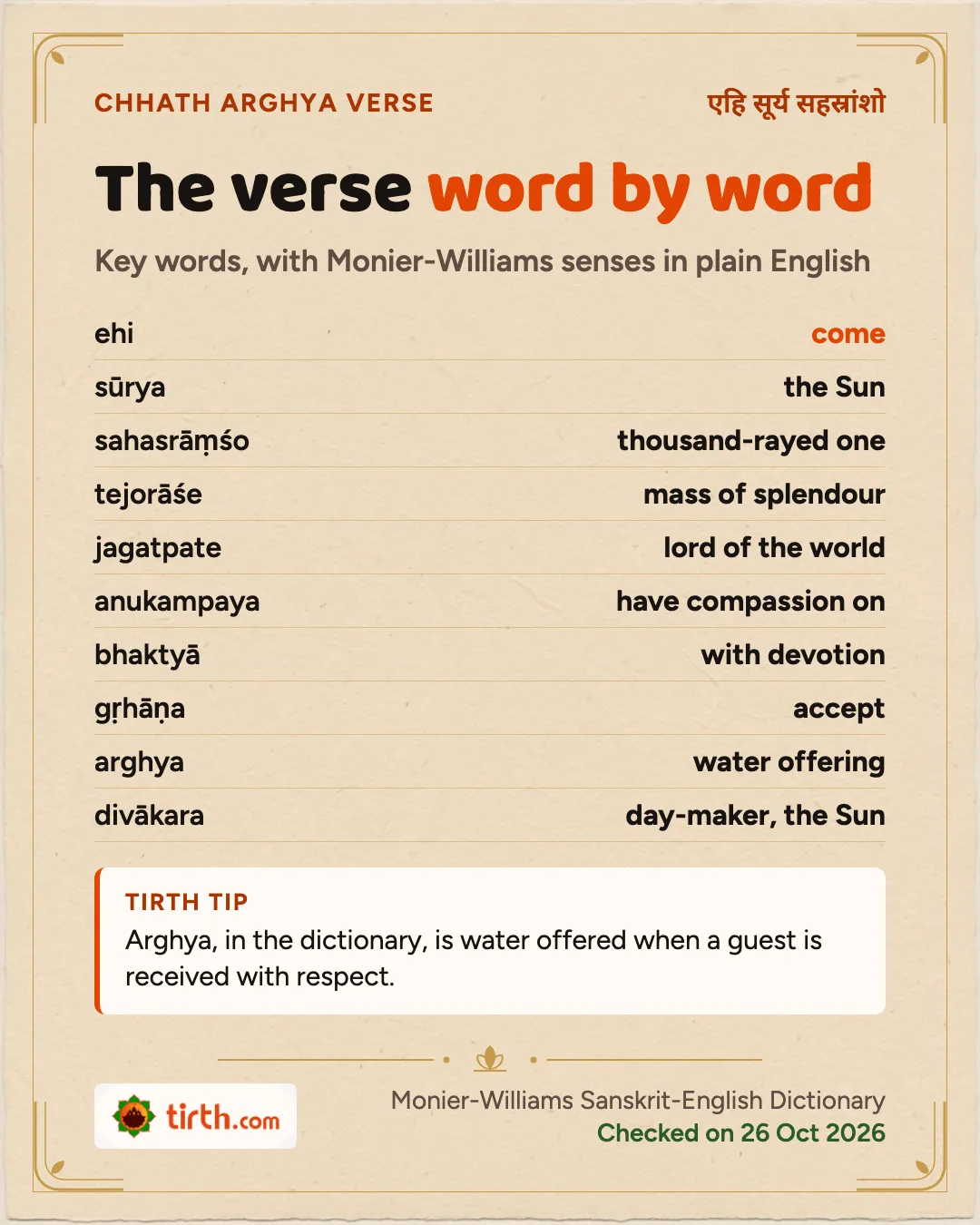
What each word of the arghya verse means
Every dictionary sense below comes from the Monier-Williams Sanskrit-English Dictionary. The last column puts that sense in everyday English. Nothing more.
| Word in the verse | Dictionary headword | Monier-Williams sense | Plain meaning (Tirth’s rendering) |
|---|---|---|---|
| एहि (ehi) | ehi | come near! | come |
| सूर्य (sūrya) | sūrya | the sun or its deity | O Sun |
| सहस्रांशो (sahasrāṃśo) | sahasrāṃśu | thousand-rayed; the sun | thousand-rayed one |
| तेजोराशे (tejorāśe) | tejorāśi | mass of splendour | mass of splendour |
| जगत्पते (jagatpate) | jagatpati | lord of the world (also used of the sun) | lord of the world |
| अनुकम्पय (anukampaya) | anu-√kamp | to sympathize with, compassionate | have compassion on |
| मां (māṃ) | mad | base of the first person pronoun | me |
| भक्त्या (bhaktyā) | bhakti | attachment, devotion, homage, worship | with devotion |
| गृहाण (gṛhāṇa) | √grah | take, accept | accept |
| अर्घ्यं (arghyaṃ) | arghya | water offered at the respectful reception of a guest | the water offering |
| दिवाकर (divākara) | divākara | day-maker, the sun | O maker of the day |
The entry for arghya is the one to linger on. Monier-Williams defines it as the water offered when a guest is received with respect.
Om suryaya namah and the two name mantras said with it
ॐ सूर्याय नमः
ॐ आदित्याय नमः
ॐ भास्कराय नमः
oṃ sūryāya namaḥ
oṃ ādityāya namaḥ
oṃ bhāskarāya namaḥ
Each of the three lines names the Sun differently. Surya is the sun or its deity. Aditya means son of Aditi and is a name of the Sun, and Bhaskara means “making light”. Dekho Panchang’s Chhath guide places these three just before the arghya verse. Drik Panchang lists all three among the 13 names said in Surya Namaskar (Mitra, Ravi, Surya, Bhanu, Khaga, Pushan, Hiranyagarbha, Marichi, Aditya, Savitri, Arka, Bhaskara and Savitri-Surya-Narayana).
They are short enough for a child to learn on the walk to the ghat. For longer prayers to the same deity, see more Surya mantras, or read about the deity on the Bhagwan Surya page.
When the arghya verse is said over the four days of Chhath
Chhath falls in the bright half of the Kartika month, and its four days follow the tithis.
- Nahay Khay, the first day, on Kartika Shukla Chaturthi.
- Kharna, the second day, on Panchami.
- Sandhya Arghya, the evening offering to the setting Sun, on Shashthi.
- Usha Arghya, the dawn offering to the rising Sun, at sunrise on Saptami.
The arghya verse belongs to the last two days, said at sunset and again at sunrise. How many times to say it is a family matter. The sources here set no count for Chhath, though Amar Ujala’s guide to daily Surya arghya gives the verse 11 times while the water is offered.
If you learn only one line before the ghat, make it the arghya verse, because it is the line said at the moment the water is poured. If your mother or an elder leads the arghya, follow theirs. Two more pages for Surya on Tirth are the Surya Dev Aarti and the Surya Dev Chalisa.
Frequently asked questions
Which mantra is said at Chhath arghya?
The arghya verse, ॐ एहि सूर्य सहस्रांशो तेजोराशे जगत्पते। अनुकम्पय मां भक्त्या गृहाणार्घ्यं दिवाकर॥, is the one said as the water is offered. Dekho Panchang’s Chhath guide places three name mantras before it: ॐ सूर्याय नमः, ॐ आदित्याय नमः and ॐ भास्कराय नमः.
What does “Ehi Surya sahasransho” mean?
It means “Come, O Sun, thousand-rayed one”. The full verse goes on to call the Sun a mass of splendour and lord of the world, and asks him to have compassion and accept the water offering, given with devotion.
How many times is the arghya verse said?
The sources used here give no fixed count for Chhath, so follow your family’s practice. Amar Ujala’s guide to offering water to the Sun every day gives the verse 11 times.
Which scripture is the Chhath arghya verse from?
None of the sources checked for this page names a scripture for it, so it is best called the traditional arghya verse. The eight-syllable mantra ॐ घृणिः सूर्य आदित्यः does have a named source, the Surya Upanishad of the Atharvaveda.
Is Aditya Hridayam recited on Chhath?
The sources used here do not name it as part of the Chhath arghya. It is a separate hymn to the Sun of 31 verses, taught by Agastya to Shri Ram in the Yuddha Kanda of the Valmiki Ramayana. If your family recites it, the full text is on valmikiramayan.net.