
Brahma Mantra: Gayatri Text, Meaning and Source
Tirth editorial · 10 Jan 2026 · 7 min read
Hiranyagarbha, the golden womb, is the word that turns this mantra towards Bhagwan Brahma. The Brahma mantra most people are looking for is the Brahma Gayatri of the Mahanarayana Upanishad, a one-line prayer to Bhagwan Brahma as Hiranyagarbha, the root of the four Vedas, asking him to turn our awareness toward right action.
The second line that carries his name is the Guru verse, gurur brahma, from the Guru Gita. Both are given below, each with the book it comes from and the place in that book where you can check it for yourself.
Vedatmanaya vidmahe, the Brahma Gayatri as printed
The Mahanarayana Upanishad gives the verse in this form.
vedatmanaya vidmahe hiranyagarbhaya dhimahi | tanno brahma prachodayat
Look at the first word. The printed spelling is vedatmanaya, and that is the form to learn and to write down if you keep the verse in a notebook for daily use.
The Kamakoti edition’s English renders the whole line as a prayer to Bhagwan Brahma as Hiranyagarbha, the form in which the Supreme Reality is known to us and the root of the four Vedas that were recited from his four faces, to set our awareness on right action. That is a sentence meaning for the full line, and the edition gives no word-by-word meaning to go with it.
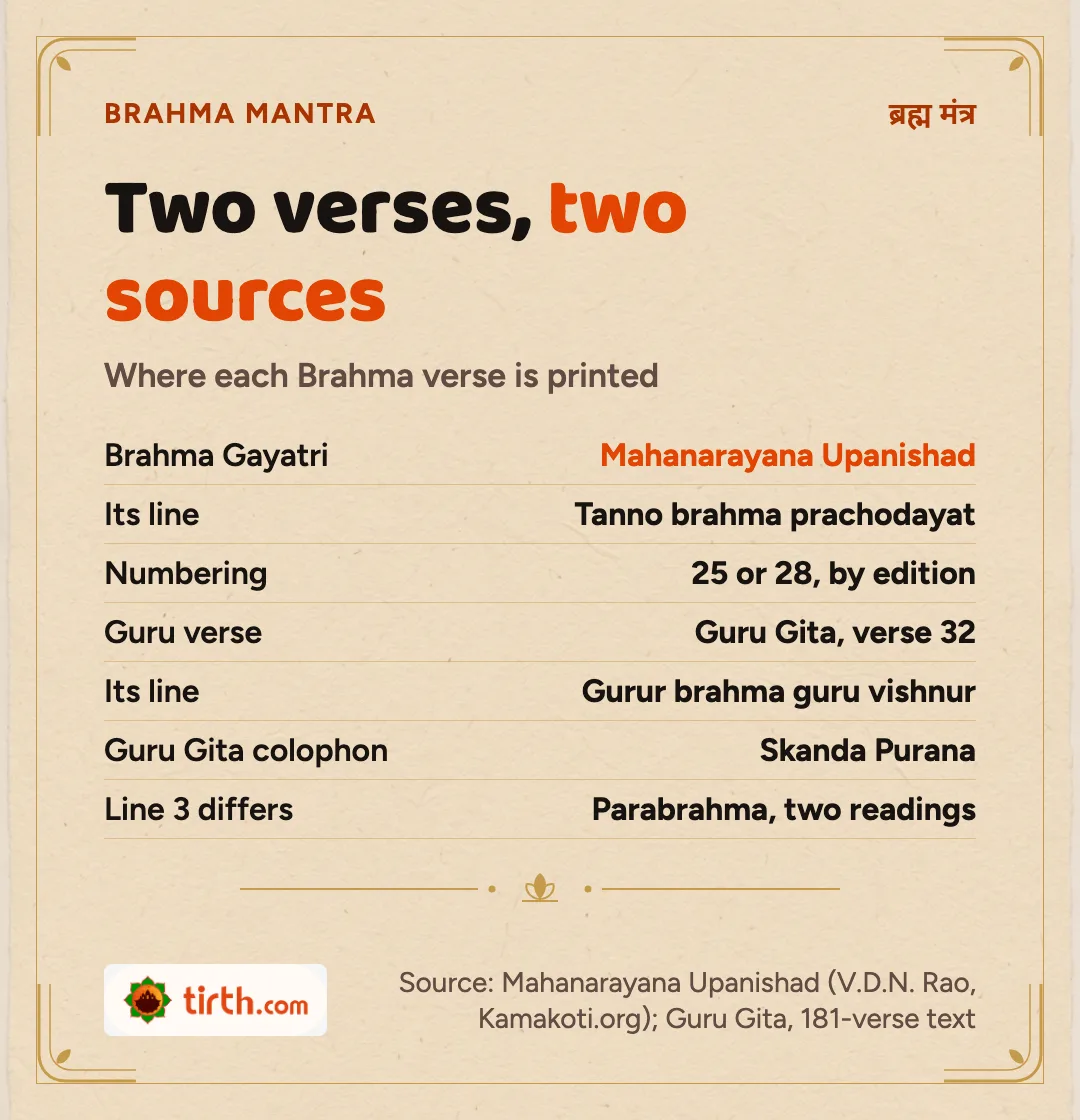
Which number to quote depends on the book in your hands. The Kamakoti edition counts the Brahma Gayatri as number 25 in its set of gayatris, while the Mahanarayana Upanishad text on the Sri Vaishnavism site (Section I, verses 19 to 33) prints it as verse 28, so cite the Upanishad by name and say that the numbering varies by edition.
It is one verse in a series. The same run of gayatris has verses for Rudra, Ganesha, Nandi, Shanmukha, Aditya, Agni and Durga, with the Garuda gayatri just before the Brahma verse and the Narayana gayatri just after it in both editions named above. We would rather you learn it as one of that set than as a stand-alone Brahma-only mantra, because that is how the Upanishad keeps it.
It is a separate verse from the Gayatri Mantra itself.
Gurur brahma guru vishnur, Guru Gita verse 32
The Guru verse opens with the name of Bhagwan Brahma. In the 181-verse text of the Guru Gita it is verse 32, and the closing colophon places the Guru Gita in the Uttara Khanda of the Skanda Purana, as a dialogue between Ishvara (Bhagwan Shiva) and Parvati.
gurur brahma guru vishnur gurur devo maheshvarah | gurur eva parabrahma tasmai shri gurave namah
That second half, gurur eva parabrahma, is how the 181-verse text prints it. A form widely chanted today reads guruh sakshat parabrahma in its place, and you will hear both. We print the edition’s line first only because it is the one a printed text gives.
That edition’s English reads: the Guru is Brahman, he is Vishnu, he is Shiva, and the Guru is indeed the Supreme Absolute. Salutations to him. Its Sanskrit spelling, brahmā, is the name of Bhagwan Brahma, the creator, which is why the verse sits on a page about him.
One traditional reading, which the edition does not print, takes the three names as creation, preservation and the dissolving of illusion and finds them together in the teacher.
Check which Guru Gita you have prior to quoting a number (editions run from about 100 to over 400 verses, so verse 32 in one book is not verse 32 in every book). For the other two names in the line there are separate pages of Vishnu mantras and Shiva mantras.
Who is Bhagwan Brahma in these verses?
The Gayatri addresses Bhagwan Brahma as Hiranyagarbha and as the root of the four Vedas. Which matches the Srimad-Bhagavatam (3.12.34), where the Vedas come from his four mouths. The Guru verse simply opens with his name.
The Rig Veda’s Hiranyagarbha hymn, 10.121, has the line hiranyagarbhah samavartatagre bhutasya jatah patireka asit, and the Mahanarayana Upanishad carries it too (Section I, chapter III, stanza 1 in the Kamakoti edition’s numbering). In Puranic usage the name goes to Bhagwan Brahma, born in a golden egg (the Manu Smriti, 1.9, is the verse usually cited).
For his forms, his four faces and the rest of his story, see the Bhagwan Brahma page on Tirth.
How did Bhagwan Brahma lose his fifth head?
The tellings do not agree. Tradition keeps more than one account of the fifth head, and each gives a different reason for how it came and how it went.
Start with Shatarupa. The Brahma Purana says Bhagwan Brahma brought forth a man and a woman from his own body, Svayambhuva Manu and Shatarupa, the first couple.
In the Matsya Purana, as an English retelling of the Puranas gives it, the extra heads grow as Bhagwan Brahma gazes at Shatarupa, and a fifth forms when she rises above him. The Shiva Purana (Vidyeshvara Samhita, chapter 8) tells it differently. There Bhairava seizes the fifth head, guilty of uttering a falsehood, to cut it off, and Bhagwan Shiva relents at the plea of Bhagwan Vishnu and stops him.
For Bhairava himself, see the Maha Kaal Bhairav beej mantra.
Chaturmukhaya vidmahe and three more lines with no named text
Search for a Brahma mantra and four more lines turn up again and again. Om Chaturmukhaya Vidmahe, Om Brahmane Namah, a seed-syllable line beginning Om Aim Hreem Shreem, and a namaskar verse beginning Om Namaste Paramam Brahma.
In the sources we checked, none of them could be tied to a named Veda, Upanishad or Purana. The Chaturmukhaya line appears in compilations that name no source, and the Sri Vaishnavism edition of the Mahanarayana notes a four-faced gayatri among other gayatris that some texts give, without saying which texts. Om Brahmane Namah has no printed source. The namaskar verse sits at the end of a Brahma Kavacham on one devotional site with no Purana or chapter given, and the Brahmastotram of the Mahanirvana Tantra, where you might expect to find it, does not contain it.
So they are left out of this page.
Three other names get mixed up with Brahma mantras in search results. The Panchabrahma mantras come from the Panchabrahma Upanishad and are about the five faces of Bhagwan Shiva. Aham Brahmasmi is a different thing again, a Mahavakya of the Brihadaranyaka Upanishad. And the Tarakabrahma mantra is a mantra of Shri Ram.
When should you chant the Brahma Gayatri?
The editions named on this page give no count, time of day or direction to face for either verse.
Lists online add bathing first, facing east, celibacy, avoiding tamasic food and chanting in Brahma Muhurta, along with long lists of benefits. Keeping those habits is a family matter. The texts named here do not ask for them.
If you are learning only one, learn the Brahma Gayatri with its meaning, because it is the verse that addresses Bhagwan Brahma himself, where the Guru verse addresses the Guru. And if a parent taught you the Guru verse with sakshat, say it the way they taught you.
For a puja done by a pandit, book it on Tirth. The Saraswati mantras, the Surya mantra and the rest of the set sit in the Tirth mantra library.
Frequently asked questions
What is the Brahma mantra?
Usually the Brahma Gayatri, vedatmanaya vidmahe hiranyagarbhaya dhimahi, tanno brahma prachodayat. It is a prayer to Bhagwan Brahma as Hiranyagarbha to turn our awareness toward right action.
Which scripture has the Brahma Gayatri?
The Mahanarayana Upanishad, in its set of gayatris to many deities. The Kamakoti edition numbers it 25 and another edition numbers it 28.
What does Hiranyagarbha mean?
Golden womb. The name comes from the Rig Veda’s hymn 10.121, and later texts give it to Bhagwan Brahma, born in a golden egg.
How many heads does Bhagwan Brahma have?
Four. He is Chaturmukha, the four-faced, and the Srimad-Bhagavatam (3.12.34) says the Vedas came from his four mouths. Accounts of an earlier fifth head differ on why it was lost.
What is the Guru Brahma mantra?
Gurur brahma guru vishnur, verse 32 of the Guru Gita in its 181-verse text, whose closing colophon places it in the Uttara Khanda of the Skanda Purana. It salutes the Guru as Bhagwan Brahma, Bhagwan Vishnu and Bhagwan Shiva, and as the supreme Absolute.
Is the Brahma mantra the same as Aham Brahmasmi?
No. Aham Brahmasmi is a Mahavakya of the Brihadaranyaka Upanishad, and the Brahma Gayatri comes from the Mahanarayana Upanishad.