
Bhai Dooj aarti: Yamuna aarti lyrics with meaning
Tirth editorial · 8 Jan 2026 · 6 min read
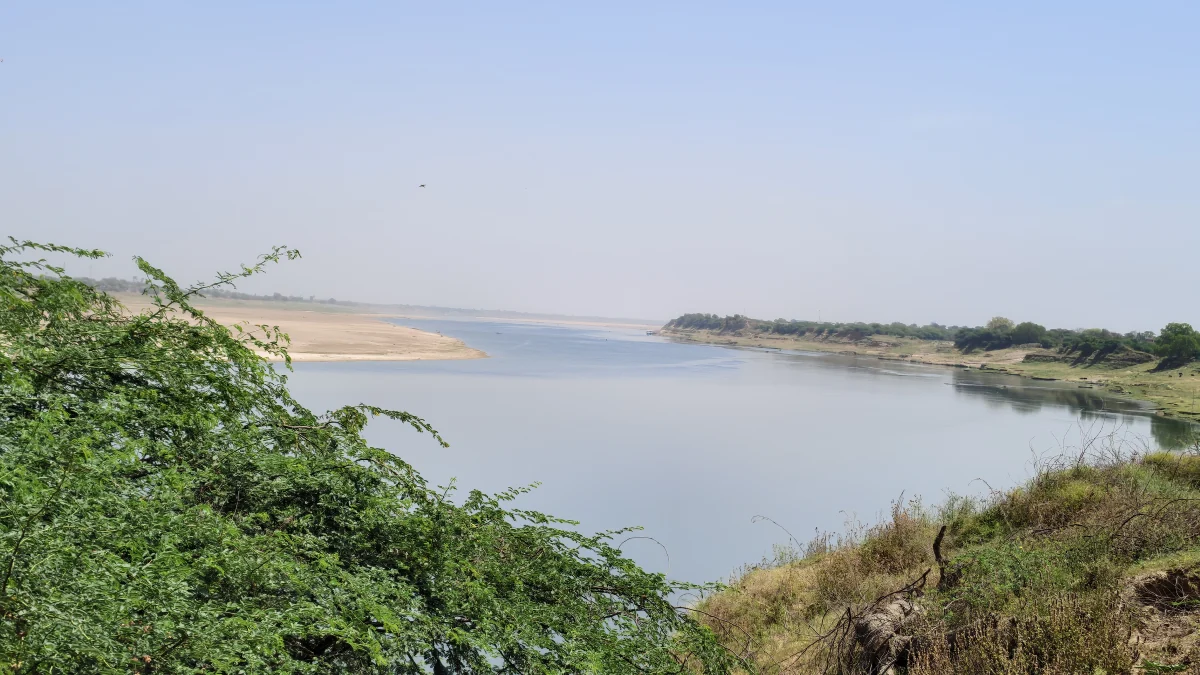
The Bhai Dooj aarti families usually sing is the Yamuna aarti, “Jai Kalindi, Haripriya jai”, sung on the day the sister puts the tilak on her brother’s forehead. The day is also Yama Dwitiya, when Yamuna fed her brother Yama at her home. The words below are as Gita Press, Gorakhpur prints them.
Everything else about the festival is in our Bhai Dooj festival guide.
Bhai Dooj in 2026: Wednesday, 11 November. Kartik Shukla Dwitiya runs from 1:59 PM on Tuesday, 10 November to 3:52 PM on Wednesday, 11 November. Aparahna (afternoon) window in New Delhi: 1:09 PM to 3:19 PM.
Checked on 26 Oct 2026. Bhai Dooj timings for your city
Dates and timings are calculated for New Delhi using the traditional North Indian panchang. Timings change from city to city; see the Tirth Spiritual Calendar for your location.
Yamuna ji ki aarti lyrics: Jai Kalindi, Haripriya jai
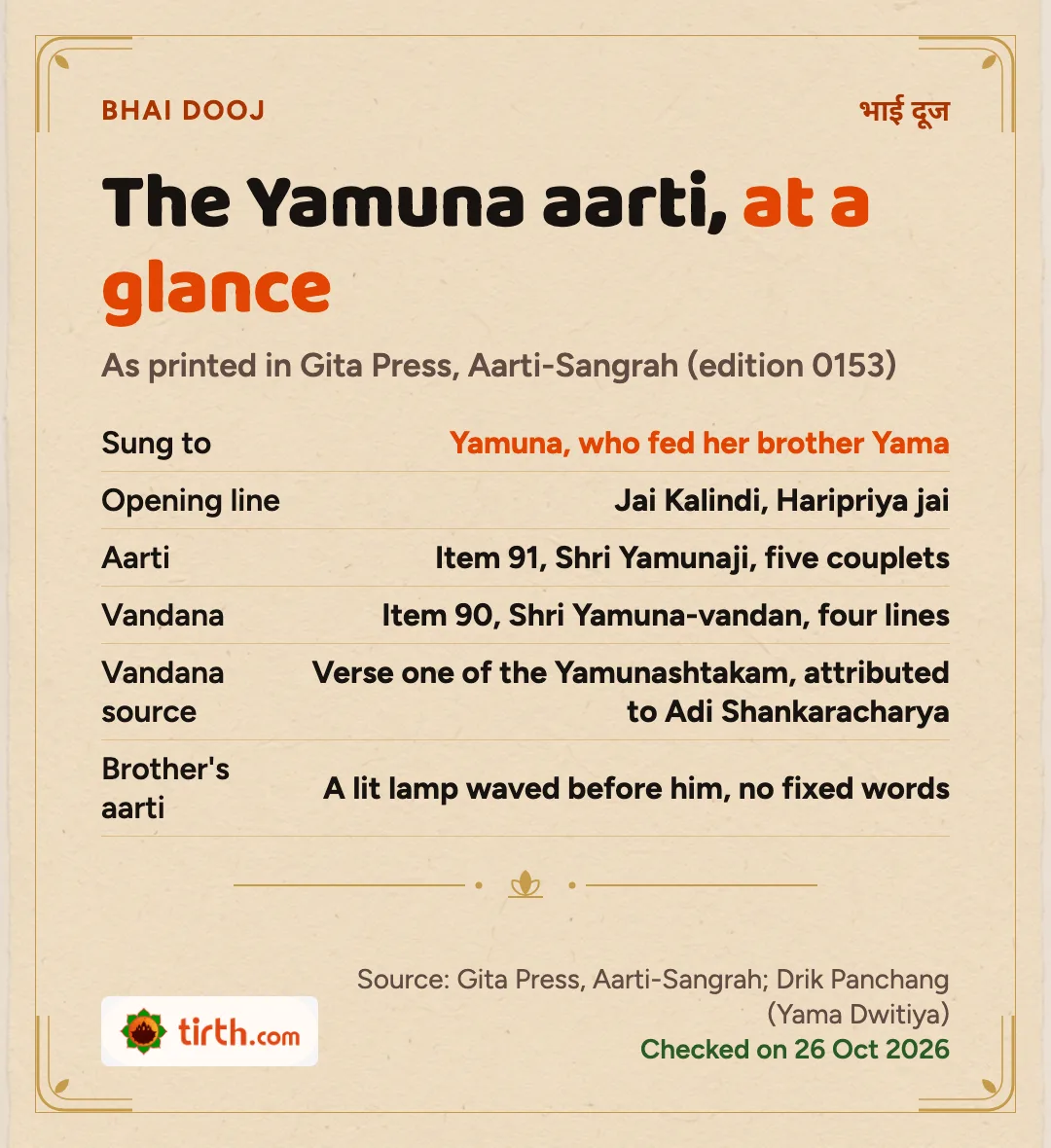
Five short couplets. In Aarti-Sangrah (book code 0153) they are item 91, printed under the title “Shri Yamunaji”, and since every half-line closes on “jai”, a family singing them for the first time can be singing along by the second couplet. Each one comes in Devanagari first, with the Roman letters under it and then a plain English meaning in Tirth’s own rendering.
जय कालिंदी, हरिप्रिया जय। जय रबि-तनया, तपोमयी जय॥
Jai Kalindi, Haripriya jai. Jai Rabi-tanaya, tapomayi jai.
Meaning: Glory to Kalindi, dear to Hari. Glory to the daughter of the Sun, full of tapas.
जय श्यामा, अति अभिरामा जय। जय सुखदा श्रीहरि रामा जय॥
Jai Shyama, ati abhirama jai. Jai sukhada Shri Hari rama jai.
Meaning: Glory to Shyama, the dark one, who is so very lovely, and glory to the giver of joy, the delight of Shri Hari.
जय ब्रज-मण्डल-वासिनि जय जय। जय द्वारकानिवासिनि जय जय॥
Jai Braj-mandal-vasini jai jai. Jai Dwarka-nivasini jai jai.
Meaning: Glory to her who lives in the land of Braj. Glory to her who lives in Dwarka.
जय कलि-कलुष-नसावनि जय जय। जय यमुने जय पावनि, जय जय॥
Jai Kali-kalush-nasavani jai jai. Jai Yamune jai pavani, jai jai.
Meaning: Glory to her who washes away the stains of the Kali age. Glory to you, Yamuna, the purifier.
जय निर्वाण-प्रदायिनि जय जय। जय हरि-प्रेम-दायिनी जय जय॥
Jai Nirvana-pradayini jai jai. Jai Hari-prem-dayini jai jai.
Meaning: Glory to the giver of liberation. Glory to her who gives love for Hari.
“Rabi” is not a slip: the printed text spells it Rabi-tanaya (रबि-तनया).
You may have come across a different, longer Yamuna aarti, “Om Jai Yamuna Mata”, which ends with the poet’s pen name “Bechain”. It is not in the Gita Press Aarti-Sangrah. The one copy we found is on a Bharatkosh wiki page that gives no reference at all, so the text on this page is the Gita Press one.
The Yamuna vandana that comes before the aarti
Item 90, just before the aarti in the book, is a four-line salutation titled “Shri Yamuna-vandan”. Where it comes from, the book does not say. It is verse one of the Yamunashtakam, a hymn to Yamuna attributed to Adi Shankaracharya.
मुरारिकायकालिमा ललामवारिधारिणी
तृणीकृतत्रिविष्टपा त्रिलोकशोकहारिणी।
मनोऽनुकूलकूलकुञ्जपुञ्जधूतदुर्मदा
धुनोतु मे मनोमलं कलिन्दनन्दिनी सदा॥
Murari-kaya-kalima-lalama-vari-dharini
Trinikrita-trivishtapa triloka-shoka-harini.
Mano’nukula-kula-kunja-punja-dhuta-durmada
Dhunotu me mano-malam Kalinda-nandini sada.
Plain meaning (Tirth’s rendering), line by line: She carries water made lovely by the dark colour of Murari’s (Krishna’s) body. She holds heaven as light as a blade of grass and takes away the sorrow of the three worlds. Along her pleasant banks the clustered groves shake off arrogance. May the daughter of Kalinda always wash the dirt from my mind.
Learn the aarti first. It is short and its refrain repeats. The vandana is a single Sanskrit verse made of long compound words, so read it aloud a line at a time on the evenings before the day.
Why do families sing to Yamuna on Bhai Dooj?
The Gita Press Aarti-Sangrah we checked has no Bhai Dooj item. The link to Yamuna comes from the day’s story.
On Kartik Shukla Dwitiya, the story goes, Goddess Yamuna fed her brother Yama (Yamraj) at her home, and he was pleased enough to give his blessing in return. Tradition holds that sisters who feed their brothers on this day stay blessed in marriage, and that brothers who eat at a sister’s home live long. So the day carries his name as well, Yama Dwitiya, and the aarti goes to his sister, who fed him at her home.
The story as it is told at home is in our Yama Dwitiya vrat katha.
Where a family keeps it, Yama has his own puja that afternoon. For his own aarti, see our Dharmaraj aarti.
How does a sister do her brother’s aarti and tilak?
Where your family’s custom differs, follow your family. The full order of the day, from the morning bath to the meal, is in our Bhai Dooj festival guide; the aarti and tilak are below.
- Sing the Yamuna vandana and aarti from above if your family does.
- Sit your brother down facing you. Put the tilak on his forehead and wave the lit lamp before him, which is his aarti and has no set words.
Chitragupta gets his puja on this day too, mostly in Kayastha families.
Two more aartis sit close to this one, the Govardhan Maharaj aarti from the same Diwali week (the Diwali guide lays out the five days) and the Ganga aarti for another river goddess. Every festival of the season, with its date and timings, is in the Tirth festival calendar.
Frequently asked questions
Which aarti is sung on Bhai Dooj?
The Yamuna aarti, “Jai Kalindi, Haripriya jai”, is the usual one, in the words Gita Press prints in Aarti-Sangrah. Her brother’s own aarti is separate. She waves a lit lamp before him, with no fixed words to go with it.
Why is Yamuna worshipped on Bhai Dooj?
Because of the day’s story. On Kartik Shukla Dwitiya Yamuna fed her brother Yama at her home, and Yama gave his blessing in return. Tradition holds that a sister who feeds her brother on this day stays blessed in marriage, and that a brother who eats at her home lives long.
How does a sister do the aarti of her brother on Bhai Dooj?
She seats her brother, puts the tilak on him and waves a lit lamp before him. That lamp is his aarti, and it has no set words.
What time is good for Yama puja on Bhai Dooj?
The Aparahna, the afternoon part of the day, is the preferred time for Yama puja on Bhai Dooj. The window moves from one city to the next. Look up the Bhai Dooj timings for your city.
What is Yama Dwitiya?
It is Bhai Dooj under another name, the Dwitiya of the bright half of Kartik. Yama gives the day its name, because on it he ate at his sister Yamuna’s home.
Continue on Tirth
- Tirth: Bhai Dooj in the Tirth Spiritual Calendar, with timings by city.