
Bhai Dooj: the story of Yama and Yamuna, the tilak and the rituals
Tirth editorial · 11 Feb 2026 · 9 min read
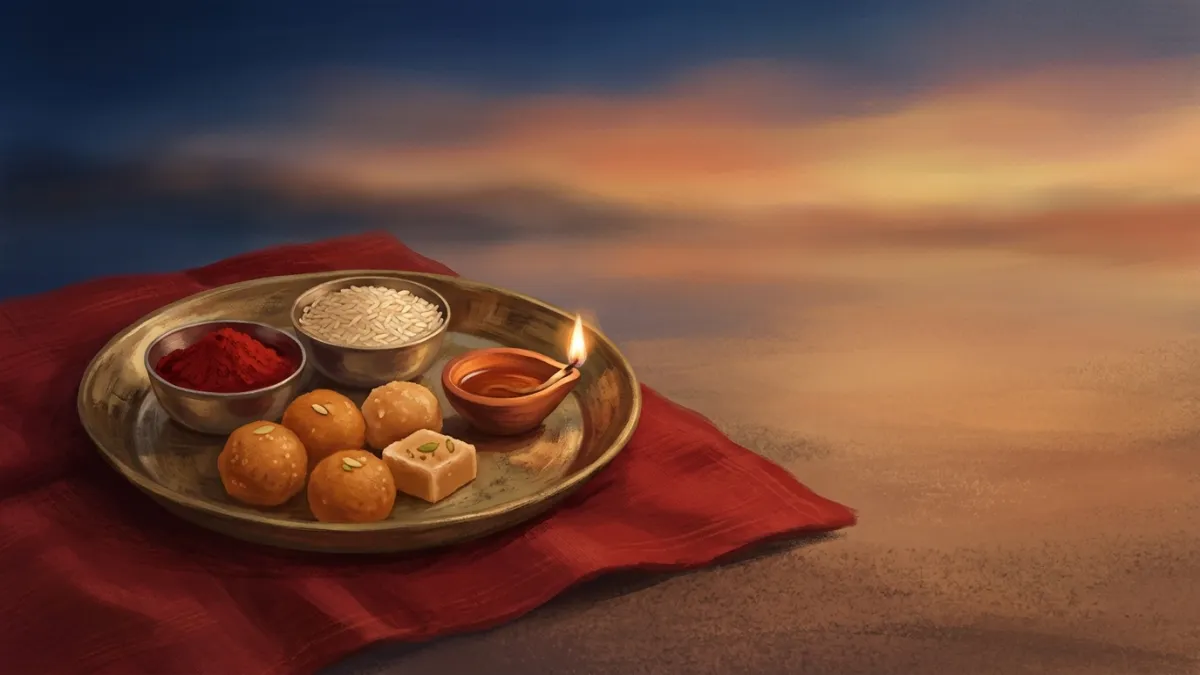
Bhai Dooj is the day a sister puts a tilak of roli and rice on her brother’s forehead, waves a lit lamp before him for his aarti, feeds him sweets and a meal, and prays that he lives a long life. He gives her a gift in return.
Its other name is Yama Dwitiya, and the Skanda Purana has the story behind it. Yamuna keeps inviting her brother Yama to eat at her house, and his work keeps him away every time, until one day in Kartika he walks up to her door and she gets to look after him at last. A bath, anointing, food, honour. He leaves ornaments and clothes behind for her.
The day is the second lunar day of the bright half of Kartika. In 2026 it falls the day after Govardhan Puja, and our guide to the Diwali festival covers the days that lead up to it.
Bhai Dooj in 2026: Wednesday, 11 November. Kartika Shukla Dwitiya: 1:59 PM on Tuesday, 10 November to 3:52 PM on Wednesday, 11 November. Tilak window (aparahna) in New Delhi: 1:09 PM to 3:19 PM.
The days around it in 2026: Dhanteras on Friday, 6 November; Narak Chaturdashi and Lakshmi Puja on Sunday, 8 November; Govardhan Puja on Tuesday, 10 November.
Checked on 25 Oct 2026. Timings for your city in the Tirth Spiritual Calendar
The date card is worked out for New Delhi. Timings shift from city to city, so check the Tirth panchang calendar for where you live.
Bhai Dooj meaning, and the names it goes by
Bhai means brother. Dooj is how people say Dwitiya, the second lunar day, so the name comes out as “the brother’s second day”. Kartika Shukla Dwitiya, the second day of Kartika’s bright fortnight, is the one meant.
Yamadvitiya, Yama’s second day, is how Sanskrit says it. Look it up in Apte and you get the day on which sisters entertain their brothers, with Bhratri Dwitiya (the brothers’ second day) given as a second name for it. Molesworth’s Marathi dictionary points from Yamadvitiya to bhaubij, another name for the same day.
In Maharashtra the day is Bhau Beej.
Elsewhere people say Bhaiya Dooj, Bengal says Bhai Phota or Bhai Phonta, and in Nepal it is Bhai Tika.
In 2026 Bhai Dooj comes three days after Lakshmi Puja, as the date card above shows. Counting two days from Diwali would land on the wrong day this year.
Yama, Yamuna and the chapter in the Skanda Purana
The Markandeya Purana makes Lord Yama and Goddess Yamuna twins, born to Vivasvan (Surya, the Sun) and Sanjna, the daughter of Vishvakarma, and in that text the sister goes by two names, Yamuna and Yami.
For the Bhai Dooj story itself, turn to the Skanda Purana. The section is the Kartikamasa-mahatmya in the Vaishnava Khanda, and chapter 11 there carries the title “The Efficacy of Yamadvitiya” in the English translation by Tagare. See our guide to the Kartika Mahatmya.
Invitation after invitation comes from Yamuna, and Yama puts each one off because his duties hold him. On this day he comes. Bathing him and anointing him, she sets food before him and honours him, and Yama returns the honour with ornaments and clothes for his sister.
Then the Purana says what the day brings. According to the chapter, the man who takes his meal in his sister’s house on Yamadvitiya is spared an untimely death and never sees the abode of Yama. As for the sister who feeds him, she will never be widowed, and his lifespan will not grow shorter. Families who keep the day hold these words as belief, and no one can promise them to you. For the fuller retelling, read the Yama Dwitiya vrat katha.
A second story also does the rounds. In it Shri Krishna, having killed Narakasura, goes to his sister Subhadra, and she receives him with aarti, tilak, flowers and sweets. Many families tell it. We could not trace it to any scripture, so we give it here as a family story.
Why does the tilak wait for the afternoon?
Kartika Shukla Dwitiya has to be running during the aparahna, the afternoon part of the day. The Skanda Purana chapter is not of one voice here: one verse places Yama’s worship in the afternoon, and an earlier verse names the forenoon.
The tilak window on the date card is that afternoon part.
If your brother is only free after dark, check the hour Dwitiya ends that day before anyone settles on dinner. The window moves from city to city, so open the timings for your city before you fix the hour.
Bhai Dooj tilak vidhi at home
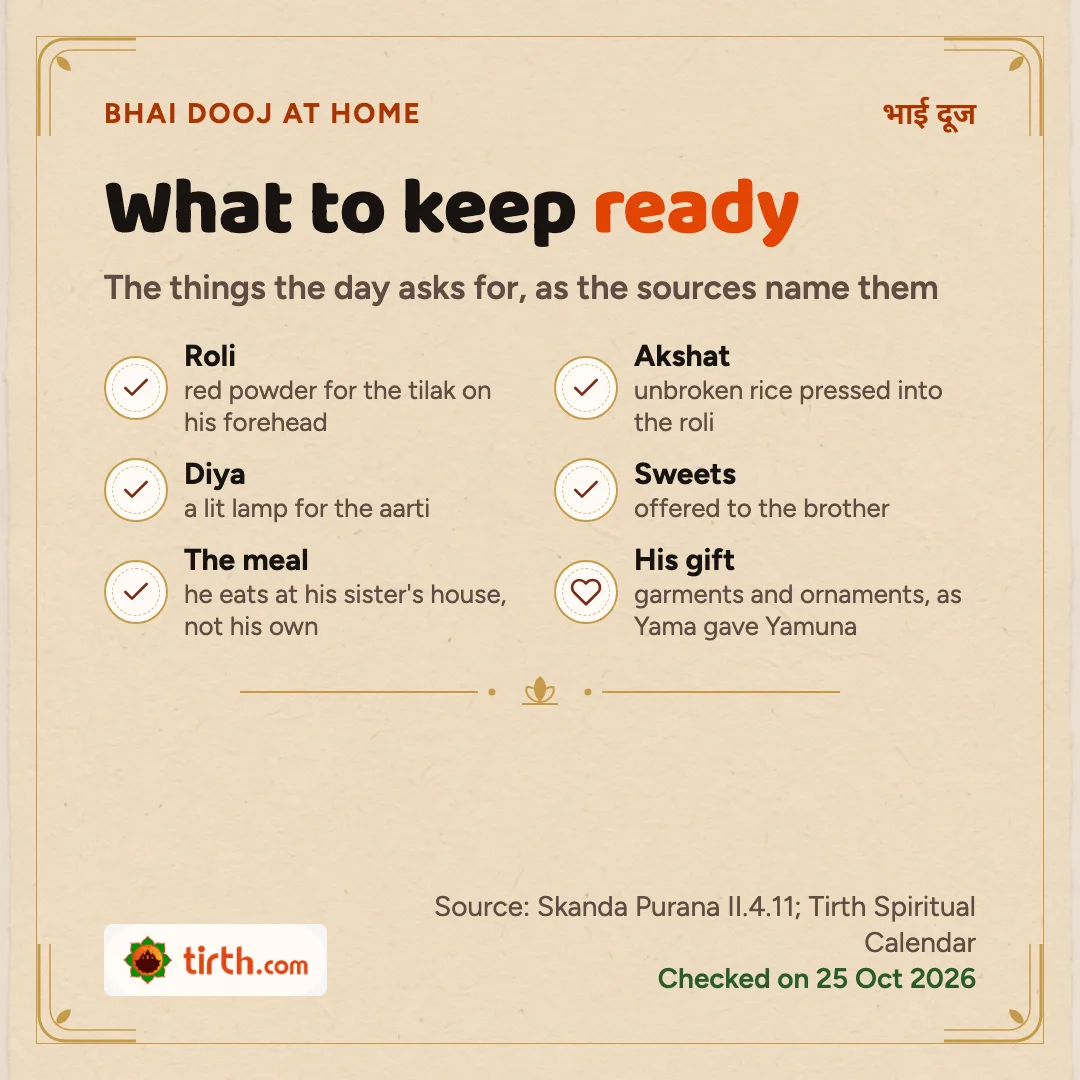
All of this can be done at home. The sources name these parts of the day but give no fixed order for them.
- A morning bath. On this day, by the Skanda Purana, bathing in the Yamuna earns merit, and so does water offered to the Pitrs (ancestors) and the Devas, and many families take the Yamuna snan (a holy dip) in the morning.
- The thali, with the checklist just below. Sisters in Maharashtra, in one popular custom, draw a square on the floor for him to sit inside, and in some homes there he bites a bitter fruit called karith before the tilak. Follow that only if your own family does.
- The tilak of roli and rice on his forehead, in the afternoon window.
- The aarti, with a lit lamp circled in front of him. The words, if you would like to sing, are in the Bhai Dooj aarti.
- Sweets and a meal, with a prayer for his long life. On Yamadvitiya, the Purana says, a man should eat at his sister’s house and not in his own.
- His gift to his sister. Garments and ornaments are what the Purana names, the same things Yama left with Yamuna.
Some households also do a puja for Yama himself. In the afternoon, they worship Yamraj along with Chitragupta and the Yamadutas (Yama’s messengers), and offer an arghya (water offering) to Yama. The Skanda chapter does not mention Chitragupta, so follow your own family’s custom here.
A Bhai Dooj thali checklist
| Item | What it is for | Where it is used |
|---|---|---|
| Roli (red powder) | The tilak | North India |
| Akshat (unbroken rice) | Pressed into the roli tilak | North India |
| Diya (oil lamp) | The aarti | North India |
| Sweets | Offered to the brother | North India; Nepal serves sweets after the tika |
| The meal | Eaten by the brother at his sister’s house | Asked for in the Skanda Purana |
| Sandalwood paste, kajal and ghee | The phota on the forehead | Bengal (Bhai Phota) |
| Seven-coloured tika, makhamali (globe amaranth) garland, walnuts, sel roti | Tika, garland and the sweets that follow | Nepal (Bhai Tika) |
No sister to do the tilak? What the Purana allows
Without a sister of his own, the Skanda Purana says, a man should go and eat with one of five women the chapter names: his father’s sister, an elder sister, the daughter of a paternal uncle, his mother’s sister or the daughter of a maternal uncle. If nobody on that list can host him, then with a woman he regards as a sister. The chapter goes one step further still, and lets a cow, a river or a forest take her place.
For brothers the chapter is brief. Eat at your sister’s house that day, not your own, and give her garments and ornaments. If you live near the Yamuna, bathe in it, which the chapter links with merit.
How Bhai Dooj changes from Maharashtra to Bengal and Nepal
Most of the traditions below put a mark on the brother’s forehead, and they differ in what the mark is made of and what goes with it.
| Name | Region | What is distinctive |
|---|---|---|
| Bhai Dooj, Bhaiya Dooj, Yama Dwitiya | North India | Roli and rice tilak, aarti, sweets and a meal in the afternoon |
| Bhau Beej (Bhav Bij) | Maharashtra | The brother sits inside a square his sister draws; in some homes he bites the bitter karith fruit before the tilak |
| Bhai Phota (Bhai Phonta) | West Bengal | The sister fasts until the ceremony is done, then places a phota of sandalwood paste, kajal and ghee |
| Yama Dwitiya at Vishram Ghat | Mathura | Brothers and sisters bathe in the Yamuna together and worship at the Yama-Yamuna (Dharmaraj) temple by the ghat |
| Bhai Tika | Nepal | The last day of Tihar: a seven-coloured tika and makhamali garlands, then sweets, walnuts and sel roti |
In Bengal the sister fasts until the phota is on her brother’s forehead.
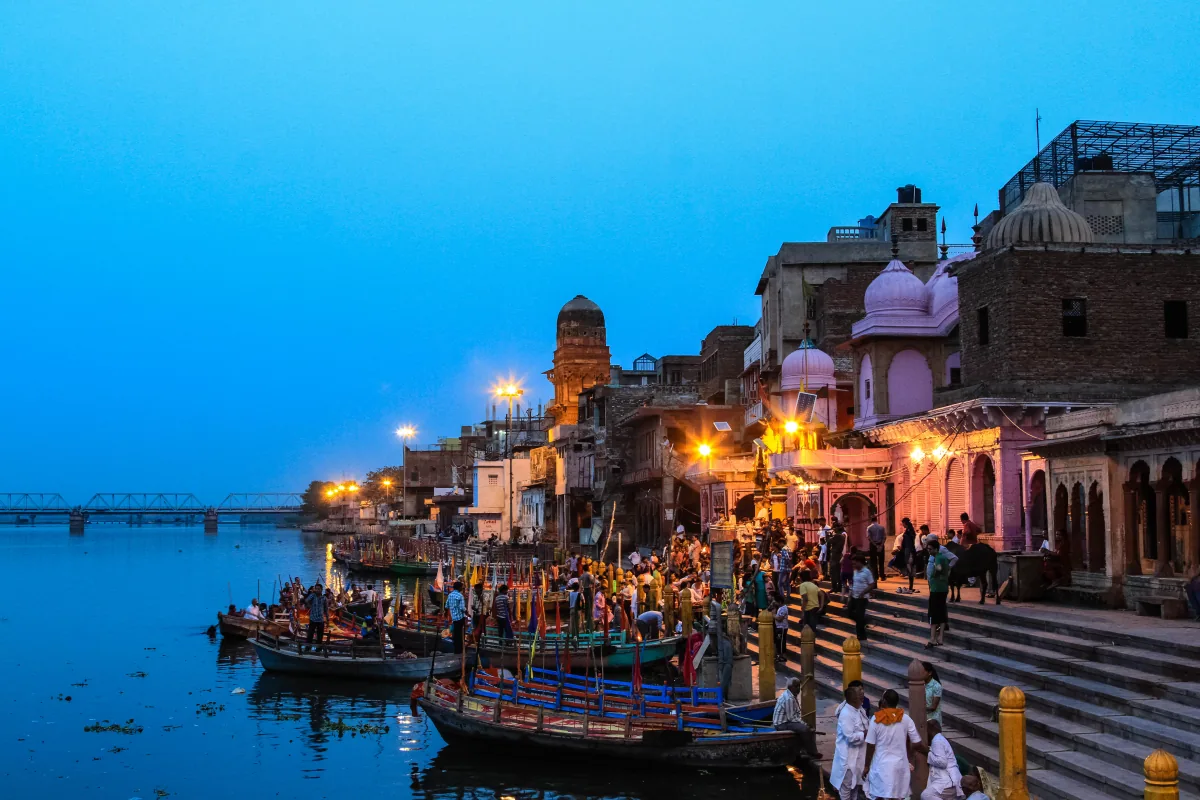
In Mathura, Vishram Ghat sits on the Yamuna. On Yama Dwitiya brothers and sisters bathe there together and worship at the temple of Yama and Yamuna by the ghat.
In Nepal, the calendar committee names an auspicious hour for Bhai Tika each year.
Bhai Dooj and Raksha Bandhan, side by side
People mix the two up because both are about brothers and sisters. Bhai Dooj means a tilak and a meal at the sister’s house, and its story is Yama’s visit to Yamuna in the Skanda Purana. Raksha Bandhan is about the rakhi a sister ties on her brother’s wrist, and it comes in a different month of the year. Our page on why Raksha Bandhan is celebrated tells that story.
In 2026 Govardhan Puja falls the day before Bhai Dooj. For every festival of the season dated for your own city, open the Tirth Spiritual Calendar.
Frequently asked questions
What is the story behind Bhai Dooj?
Yamuna invited her brother Yama to eat at her house again and again, the Skanda Purana says, and on Kartika Shukla Dwitiya he finally came. She bathed him, anointed him and fed him. He gave her ornaments and clothes. People also tell a version with Shri Krishna and Subhadra, though we have found no scripture behind that one.
What is put in the Bhai Dooj tilak?
In North India the tilak is roli, with grains of unbroken rice pressed in. Bengal’s phota is sandalwood paste, kajal and ghee, and in Nepal sisters put on a seven-coloured tika.
What does a brother give his sister on Bhai Dooj?
Garments and ornaments, says the Skanda Purana, the same things Yama gave Yamuna.
Is Bhai Dooj the same as Raksha Bandhan?
No. Bhai Dooj falls on Kartika Shukla Dwitiya and is a tilak and a meal at the sister’s house, tied to Yama and Yamuna. The rakhi thread belongs to Raksha Bandhan, which comes in another month.
What is Bhai Dooj called in Bengal, Maharashtra and Nepal?
It is Bhai Phota or Bhai Phonta in Bengal and Bhau Beej or Bhav Bij in Maharashtra, while Nepal keeps it as Bhai Tika on the last day of Tihar. Sanskrit texts use Yamadvitiya or Bhratri Dwitiya.
What if a brother has no sister?
He can eat with a father’s sister, an elder sister, a paternal or maternal cousin sister, or a mother’s sister, the Skanda Purana says. If none of them can host him, a woman he regards as a sister will do, or even a cow, a river or a forest.