
What Diwali means: the history and meaning of Deepavali
Tirth editorial · 5 Feb 2026 · 11 min read
Avali means a row. It is the half of the word people tend to forget, and it carries most of the Diwali meaning, because Diwali is only the everyday form of the Sanskrit dipavali, dipa (a lamp) joined to avali, which gives you a row of lamps. The night is the new moon (Amavasya) of Kartika, going by the way North India counts its months.
Diwali in 2026: Sunday, 8 November. Amavasya in New Delhi from 11:27 AM that day to 12:30 PM the next. Narak Chaturdashi falls the same morning and Kali Puja the same night.
Checked on 25 Oct 2026. Timings for your city in the Tirth Spiritual Calendar
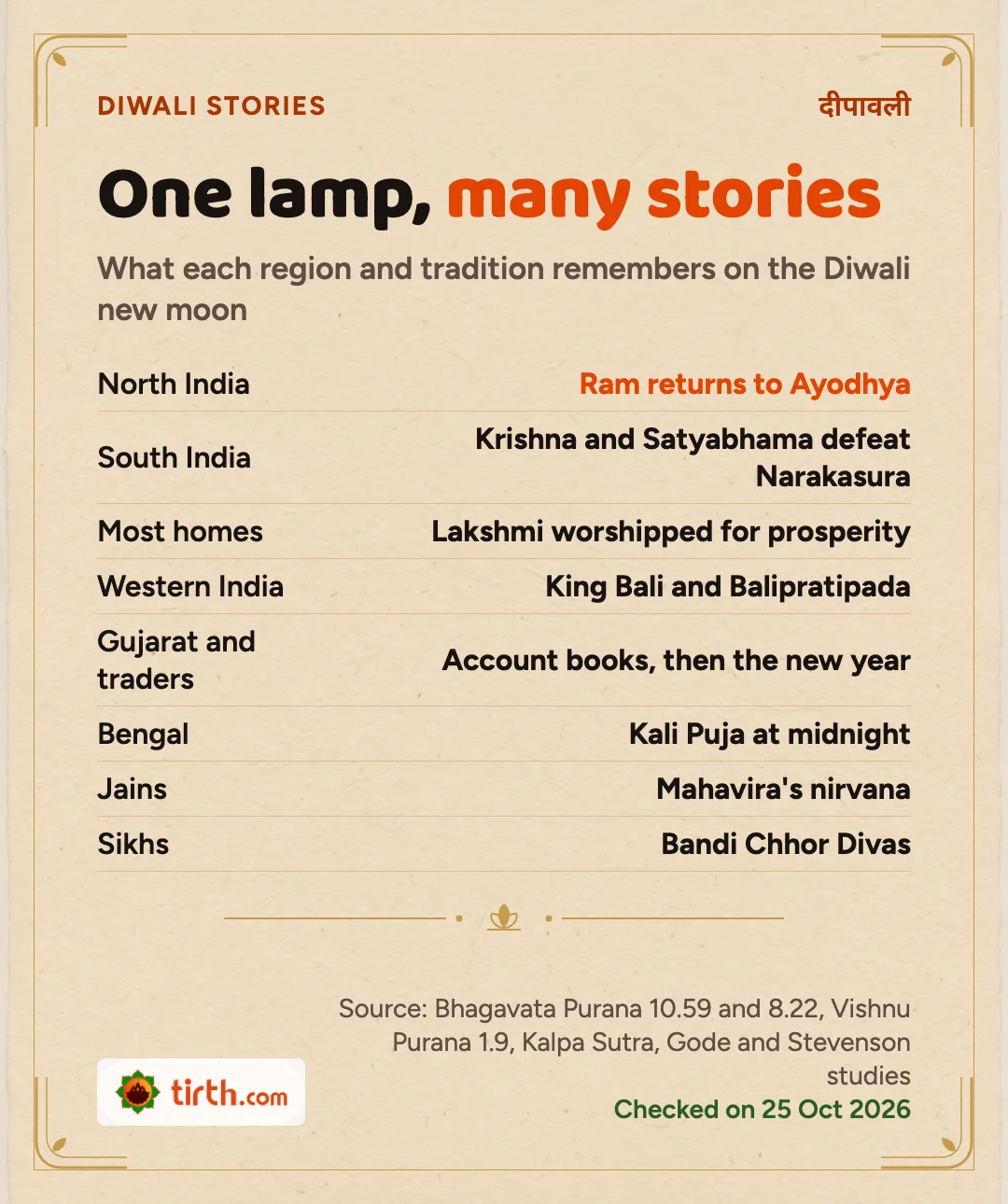
Every region hangs its own story on those lamps. Shri Ram comes home to Ayodhya, Krishna and Satyabhama defeat Narakasura, Lakshmi rises from the ocean, western India remembers King Bali, Bengal worships Maa Kali, Jains remember Mahavira’s nirvana and Sikhs remember Guru Hargobind Sahib reaching Amritsar. The puja and the five days have a page of their own, our Diwali festival guide.
Dipa plus avali: what Deepavali means in Sanskrit
Open the Monier-Williams Sanskrit-English Dictionary at dipavali and you get two senses, “a row of lights” and “nocturnal illumination”, with the Bhagavata Purana (4.21.4) given as the place the word is used. Dipa by itself means a lamp or a light. Avali is any row or continuous line. On the night, look at a roof or a wall or the edge of a doorstep with lamps in a line along it, and you have the name in front of you.
Sanskrit has older names for the festival too. The same dictionary lists Dipali, the festival of illuminations at the new moon of Ashwin or Kartika, then Dipamala and Dipamalika (a row of lights), Dipotsava (a festival of lights, from the Bhavishya Purana) and Yaksharatri, “the night of the Yakshas”, which it gives as another name for Dipali.
Spellings follow the writer, so the same night turns up as Diwali, Divali, Dipali, Deepawali or Deepavali.
Tamil Nadu and the south say Deepavali. The Ain-i-Akbari, from Akbar’s court around 1590, already has “Dipali or row of lamps”.
Why the Diwali new moon is Kartika in Delhi but Ashwin in Gujarat
Ask a family in Lucknow and a family in Ahmedabad which month Diwali falls in. You will get two answers. Both are right, because India counts its lunar months in two ways. North India follows the Purnimanta reckoning, ending each month on the full moon, which puts the Diwali new moon in the middle of Kartika. Gujarat, Maharashtra and the south use the Amanta reckoning instead, where a month ends on the new moon (so the very same night closes Ashwin).
The date itself comes from the tithi, the lunar day. Lakshmi Puja is kept on the evening when Amavasya, the new moon tithi, still holds at dusk. Bengal fixes Kali Puja by another rule, taking the day when Amavasya prevails at midnight, and when Amavasya covers both the dusk and the midnight of one day, the two fall together.
Narak Chaturdashi, the southern Deepavali morning, goes by a third clock altogether. It is the day Chaturdashi (the fourteenth lunar day) prevails at sunrise. Each of the three follows its own rule, which means the southern morning and the northern night can land on different dates, or on the same one, as the date card above shows.
Why is Diwali celebrated? Ram, Krishna, Lakshmi, Bali and Kali across India
You will not find the whole of Diwali in any one text. Each region keeps the night for its own reason, and the scriptures behind those reasons rarely mention lamps at all (worth checking for yourself, since most of the verses cited here are a click away in the sources at the end). So each story below comes with the place it is written.
Shri Ram’s return to Ayodhya, the North Indian Diwali
Ask in North India and most people will tell you Diwali is Shri Ram coming home to Ayodhya after his 14-year exile and his victory over Ravana. Valmiki puts a date on the homecoming. In Yuddha Kanda 6.124.1, once the fourteen years were complete, Ram reaches the hermitage of the sage Bharadvaja on the fifth lunar day (Panchami).
Read the rest of that sarga and you will not find a single lamp in it.
The lamps for his return come from living tradition rather than from a scene in Valmiki’s text. That is worth knowing if a child asks where the lamps are written.
Krishna, Satyabhama and Narakasura, the southern Deepavali
In South India, Deepavali belongs to Krishna and Satyabhama, and to their victory over the demon Narakasura.
The Bhagavata Purana (Canto 10, chapter 59) has Krishna riding Garuda with Satyabhama to Pragjyotishapura, where he attacks Narakasura, kills him with his disc (10.59.21) and frees the 16,000 princesses he had held captive (10.59.33). This chapter has no lamps in it either, and no festival.
The day opens in Tamil Nadu with an oil bath before sunrise. Tamil Nadu Tourism likens it to bathing in the Ganga, and after that come new clothes, puja and festive sweets.
Lakshmi from the churned ocean, the night’s main puja
On Diwali night itself, Lakshmi is the deity most widely worshipped, and families pray to her for prosperity in the coming year and thank her. Go to the Vishnu Purana (Book 1, chapter 9) for her story. The goddess Shri rises there from the churned ocean of milk, seated on a lotus, and chooses Vishnu (Hari). Nothing in the Purana ties that scene to Diwali, and the link comes only from the puja kept on the night.
Early twentieth-century scholars noticed something else about it. Some people kept the same lamp festival in honour of Lakshmi and others in honour of Durga, the celebration unchanged while the deity changed.
Two pages go with this one, how Maha Lakshmi Puja is done step by step and the Lakshmi mantras chanted with it.
King Bali and Balipratipada in western India
Western India adds King Bali to the list. Vishnu, as Vamana, sent him to rule the netherworld. Sutala is where the Lord sends him in the Bhagavata Purana (8.22.32 to 35), with a promise always to be with him and protect him. Balipratipada is the first day of the bright half of Kartika, following the Diwali new moon, the same day as Govardhan Puja.
Al-Biruni, around 1030, went further. For him Bali was the very reason for the festival, which he said was also called Balirajya, “the principality of Bali”.
Kali Puja in Bengal: the same new moon, kept at midnight
In West Bengal the Diwali new moon belongs to Maa Kali, worshipped as the destroyer of evil. Kali Puja goes on through the night. Midnight is held the most sacred hour, above all at Kalighat and Dakshineswar in Kolkata.
That is the reason Bengal dates its puja by the midnight rule, while Lakshmi Puja goes by dusk.
Account books and the Gujarati New Year
For Gujarat, and for trading families across western India, the year ends with Diwali. The records gathered in P. K. Gode’s study of the festival describe debts settled and houses whitewashed prior to it, account books worshipped on the night itself, and the next day, the first of Kartika, kept as New Year’s Day and the start of the commercial year. Even now, the first day of Kartika is the Gujarati New Year.
Why Jains and Sikhs light lamps on Diwali night
For Jains, this is the night of Mahavira’s nirvana. The Kalpa Sutra (sections 127 and 128) says that on the night Mahavira attained nirvana, his chief disciple Indrabhuti Gautama attained Kevala (perfect) knowledge. The eighteen confederate kings of Kashi and Kosala lit an illumination on the new moon day, saying, in Hermann Jacobi’s 1884 translation, “Since the light of intelligence is gone, let us make an illumination of material matter!”
Unlike the Ramayana and Bhagavata passages above, this text does speak of an illumination.
Margaret Stevenson wrote down, in the early twentieth century, how Svetambara Jain traders of western India kept the night. They worshipped their account books (Sharada Puja), wrote “Shri” on the new ledger and placed a coin on it as Lakshmi.
Bandi Chhor Divas is the Sikh name for the day. Guru Hargobind Sahib had been imprisoned by Emperor Jahangir in Gwalior Fort. He secured the release of 52 princes held with him, which earned him the title Bandi Chhor, the liberator of prisoners. He came to Amritsar at Diwali, and according to the Shiromani Gurdwara Parbandhak Committee the city lit lamps to welcome him.
So in Amritsar, Diwali and Bandi Chhor Divas are the same night. The year of his release is not agreed between sources.
How old is Diwali? From the Nilamata Purana to Al-Biruni and Akbar
It was P. K. Gode, the historian, who followed the written trail of Diwali, in a study first published in 1946 in the Annals of the Bhandarkar Oriental Research Institute and later reprinted in his Studies in Indian Cultural History (1960). He found datable evidence going back to approximately AD 500 to 600. Then he asked other scholars to look for anything older.
His trail is the table below.
| Period | Source | What it records |
|---|---|---|
| Possibly AD 50 to 400 | Kamasutra, festival list | A festival called Yaksharatri, which a 1939 scholar placed on the new moon night of Kartika. Gode accepted it as a trace of Diwali only “if this explanation is correct”. |
| Not later than the 6th or 7th century | Nilamata Purana, Kashmir | A Dipamala festival: illuminations everywhere, festoons, feasting with relatives, gambling, music and gifts of new clothes |
| 7th century | Nagananda, a play attributed to King Harsha of Kanauj (ruled 606 to 648) | A gift planned for the coming Dipapratipadutsava, a lamp festival the play’s editors identify with Diwali |
| AD 959 | Yashastilaka Champu of Somadeva Suri | The Dipotsava after Mahanavami: houses whitewashed, music and gambling, rooftops bright with rows of lights |
| c. 1030 | Al-Biruni | Dibali on the new moon of Kartika: betel leaves exchanged, alms at temples, so many lamps at night that “the air is perfectly clear” |
| 12th century | Apabhramsa poem by Abdul Rahman of Multan | Mansions lit with lamps like the crescent moon on the Dipavali night |
| c. 1420 | Niccolo de’ Conti at Vijayanagara | Innumerable oil lamps on temples and roofs, kept burning day and night |
| c. 1590 | Ain-i-Akbari | Dipali in Kartika, the great festival of the trading community, with Emperor Akbar taking part |
One caution before anyone calls a line in this table “the first Diwali”. Gode put an “if” on the Kamasutra line, so it cannot safely carry that label.
Fireworks came late. Gode concluded they must have entered Diwali after about AD 1400, once gunpowder came into use in Indian warfare, and Al-Biruni, writing some 370 years before that, describes only lamps.
What the row of lamps stands for, and the days around it
Across all these stories, Diwali stands for light over darkness and good over evil. Incredible India, the tourism ministry’s page, gives a third reading as well, knowledge over ignorance, and it sits closest to the Jain account of kings lighting lamps because “the light of intelligence” was gone.
If a child asks you what Diwali means, we would start with the word before any one story. Set down one lamp, then a second beside it, and keep going until there is a row.
Diwali night has company: Dhanteras, Govardhan Puja and Bhai Dooj (Bhai Dooj is Yamadvitiya in Sanskrit, described by Hemadri around 1260). About 15 days later Varanasi keeps Dev Deepavali, “the Diwali of the gods”, when lakhs of lamps light up the ghats.
Frequently asked questions
What does Deepavali mean in Sanskrit?
Deepavali (dipavali) joins dipa, a lamp, and avali, a row. The Monier-Williams dictionary translates it as “a row of lights” or “nocturnal illumination”, and Diwali is the everyday Hindi form of the same word.
Why is Diwali celebrated?
It depends on the region. North India marks Shri Ram’s return to Ayodhya, South India Krishna and Satyabhama’s victory over Narakasura, and most homes worship Lakshmi that night. Bengal keeps Kali Puja, Jains mark Mahavira’s nirvana and Sikhs mark Bandi Chhor Divas.
Is Diwali in the Ramayana?
The Valmiki Ramayana dates Ram’s homecoming (Yuddha Kanda 6.124.1), but the sarga does not describe lamps or an illumination. Lighting lamps for his return is a living practice rather than a scene in Valmiki’s text.
How old is Diwali?
The historian P. K. Gode found datable written evidence back to about AD 500 to 600, including a Dipamala festival in the Nilamata Purana of Kashmir. A Kamasutra festival called Yaksharatri may be older, but Gode treated that link as uncertain.
Which goddess is worshipped on Diwali?
Lakshmi is the goddess most widely worshipped on Diwali night, with families praying for prosperity in the coming year. In West Bengal the same new moon is given to Maa Kali, worshipped at midnight.
Why do Jains and Sikhs celebrate Diwali?
Jains mark the nirvana of Mahavira, when, the Kalpa Sutra says, the kings of Kashi and Kosala lit an illumination on the new moon. Sikhs mark Bandi Chhor Divas, when Guru Hargobind Sahib reached Amritsar after securing the release of 52 princes from Gwalior Fort.