
Ahoi Mata ki aarti: lyrics in Hindi and English, with meaning
Tirth editorial · 7 Jan 2026 · 8 min read
The aarti for the close of the Ahoi Ashtami puja is “Jai Ahoi Mata”, the Ahoi Mata ki aarti. It is, by Drik Panchang’s account, the most famous of Ahoi Mata’s aartis, and the one sung mostly on Ahoi Ashtami as the evening puja closes.
Eight couplets. Each one is set out in Devanagari with the Roman letters right under it, and further down every couplet gets a plain English meaning of its own.
Ahoi Ashtami falls on Sunday, 1 November 2026 (New Delhi). Ahoi Ashtami date and puja time for your city
Ahoi Mata ki aarti lyrics in Hindi and English letters
The words here are Drik Panchang’s. Webdunia prints the very same sixteen lines. “Jai Ahoi Mata” is the refrain, which opens the first couplet and is sung again after every couplet, and Drik breaks each couplet into four short half-lines (that is how the Hindi sits below, with the Roman added for anyone who sings along but does not read Devanagari).
जय अहोई माता,
जय अहोई माता।
तुमको निसदिन ध्यावत
हर विष्णु विधाता॥
जय अहोई माता…॥
Jai Ahoi Mata, jai Ahoi Mata.
Tumko nisdin dhyaavat, Har Vishnu Vidhaata.
Jai Ahoi Mata…
ब्रह्माणी, रुद्राणी, कमला
तू ही है जगमाता।
सूर्य-चन्द्रमा ध्यावत
नारद ऋषि गाता॥
जय अहोई माता…॥
Brahmani, Rudrani, Kamla, tu hi hai jagmata.
Surya-Chandrama dhyaavat, Narad Rishi gaata.
Jai Ahoi Mata…
माता रूप निरंजन
सुख-सम्पत्ति दाता।
जो कोई तुमको ध्यावत
नित मंगल पाता॥
जय अहोई माता…॥
Mata roop niranjan, sukh-sampatti daata.
Jo koi tumko dhyaavat, nit mangal paata.
Jai Ahoi Mata…
तू ही पाताल बसंती,
तू ही है शुभदाता।
कर्म-प्रभाव प्रकाशक
जगनिधि से त्राता॥
जय अहोई माता…॥
Tu hi paataal basanti, tu hi hai shubhdaata.
Karm-prabhaav prakaashak, jagnidhi se traata.
Jai Ahoi Mata…
जिस घर थारो वासा
वाहि में गुण आता।
कर न सके सोई कर ले
मन नहीं धड़काता॥
जय अहोई माता…॥
Jis ghar tharo vaasa, vaahi mein gun aata.
Kar na sake soi kar le, man nahin dhadkaata.
Jai Ahoi Mata…
तुम बिन सुख न होवे
न कोई पुत्र पाता।
खान-पान का वैभव
तुम बिन नहीं आता॥
जय अहोई माता…॥
Tum bin sukh na hove, na koi putra paata.
Khaan-paan ka vaibhav, tum bin nahin aata.
Jai Ahoi Mata…
शुभ गुण सुंदर युक्ता
क्षीर निधि जाता।
रतन चतुर्दश तोकू
कोई नहीं पाता॥
जय अहोई माता…॥
Shubh gun sundar yukta, kshir nidhi jaata.
Ratan chaturdash toku, koi nahin paata.
Jai Ahoi Mata…
श्री अहोई माँ की आरती
जो कोई गाता।
उर उमंग अति उपजे
पाप उतर जाता॥
जय अहोई माता…॥
Shri Ahoi Maa ki aarti, jo koi gaata.
Ur umang ati upje, paap utar jaata.
Jai Ahoi Mata…
Check the sixth couplet before you copy it into a puja notebook. An earlier version of this page printed it in Roman as “koi putra paata”, without the “na” before “koi”, and dropping that “na” reverses the meaning. The correct line is the one above, “na koi putra paata”.
Ahoi Mata aarti meaning in plain English
Tirth’s own plain rendering is in the right-hand column. It is built up from the dictionary meanings of the aarti’s words, as Platts and the Hindi Shabdasagar give them (both are in the sources at the end).
| Couplet | Plain meaning (Tirth’s rendering) |
|---|---|
| 1. Jai Ahoi Mata… Har Vishnu Vidhaata | Victory to Ahoi Mata. Shiva, Vishnu and Brahma meditate on you night and day. |
| 2. Brahmani, Rudrani, Kamla… Narad Rishi gaata | You are Brahmani, Rudrani and Kamla (Lakshmi); you are the mother of the world. The Sun and the Moon meditate on you, and the sage Narad sings your praise. |
| 3. Mata roop niranjan… nit mangal paata | Mother of spotless form, giver of happiness and prosperity. Whoever meditates on you receives good fortune always. |
| 4. Tu hi paataal basanti… jagnidhi se traata | You dwell in Patala, and you are the giver of good. You reveal the power of deeds, and you are the deliverer from the ocean of the world. |
| 5. Jis ghar tharo vaasa… man nahin dhadkaata | Good qualities come into the house where you dwell. What one could not do, that very thing one does, and the heart does not pound with fear. |
| 6. Tum bin sukh na hove… tum bin nahin aata | Without you there is no happiness, nor does anyone gain a son. Without you the plenty of food and drink does not come. |
| 7. Shubh gun sundar yukta… koi nahin paata | Beautiful, endowed with auspicious qualities, born of the ocean of milk. No one gains the fourteen jewels without you. (This second line is read from the matching line of the Lakshmi aarti, “ratna chaturdash tum bin koi nahin paata”.) |
| 8. Shri Ahoi Maa ki aarti… paap utar jaata | Whoever sings the aarti of Shri Ahoi Maa, great joy springs up in the heart and sin falls away. |
Har means Shiva and Vidhaata means Brahma, the creator. Put Vishnu between them and the first couplet is naming Shiva, Vishnu and Brahma.
Basanti comes from basna, to dwell (couplet 4). Where the Ahoi text has basanti, the matching Lakshmi line has paataal-nivaasini, dweller in Patala, which says the same thing. Jagnidhi, the ocean of the world, stands for worldly life.
Tharo is just “your”. In couplet 7, jaata means born of, so kshir nidhi jaata is born of the ocean of milk.
Is the Ahoi Mata aarti in the Gita Press Aarti-Sangrah?
Not in Part 2 (Bhag 2).
The scanned copy on archive.org has no Ahoi Mata aarti in it, and neither Drik Panchang nor Webdunia gives a name for who wrote the text.
Item 15 on page 18 of that same volume is another aarti, the one headed Shri Lakshmiji (“Om Jai Lakshmi Mata”). Set the two next to each other and the Ahoi aarti runs parallel to it couplet by couplet. Often the wording is the same or nearly so, as in these three pairs.
| Couplet | Shri Lakshmiji (Gita Press) | Ahoi Mata (Drik Panchang) |
|---|---|---|
| 4 | तुम पाताल-निवासिनि, तुम ही शुभदाता। कर्म-प्रभाव-प्रकाशिनि, भवनिधिकी त्राता | तू ही पाताल बसंती, तू ही है शुभदाता। कर्म-प्रभाव प्रकाशक जगनिधि से त्राता |
| 6 | तुम बिन यज्ञ न होते, वस्त्र न हो पाता। खान-पानका वैभव सब तुमसे आता | तुम बिन सुख न होवे न कोई पुत्र पाता। खान-पान का वैभव तुम बिन नहीं आता |
| 7 | शुभ-गुण-मन्दिर सुन्दर, क्षीरोदधि-जाता। रत्न चतुर्दश तुम बिन कोई नहिं पाता | शुभ गुण सुंदर युक्ता क्षीर निधि जाता। रतन चतुर्दश तोकू कोई नहीं पाता |
Look at couplet 7. The Gita Press text reads kshirodadhi-jaata, born of the ocean of milk, and in that aarti the words are said of Maa Lakshmi, since it is headed Shri Lakshmiji and its last couplet calls itself the aarti of Mahalakshmi.
The printed Ahoi texts do not agree on every spelling either. Webdunia has Braahmani where Drik Panchang has Brahmani, and writes chandrama and maa a little differently (this page keeps Drik Panchang’s readings throughout).
Couplet 5 ends “man nahin ghabraata” in the Lakshmi text and “man nahin dhadkaata” in the Ahoi texts.
If it is the Lakshmi side you are after, there is the Mahalakshmi Chalisa, and a page of Lakshmi mantras.
When is the aarti sung in the Ahoi Ashtami puja?
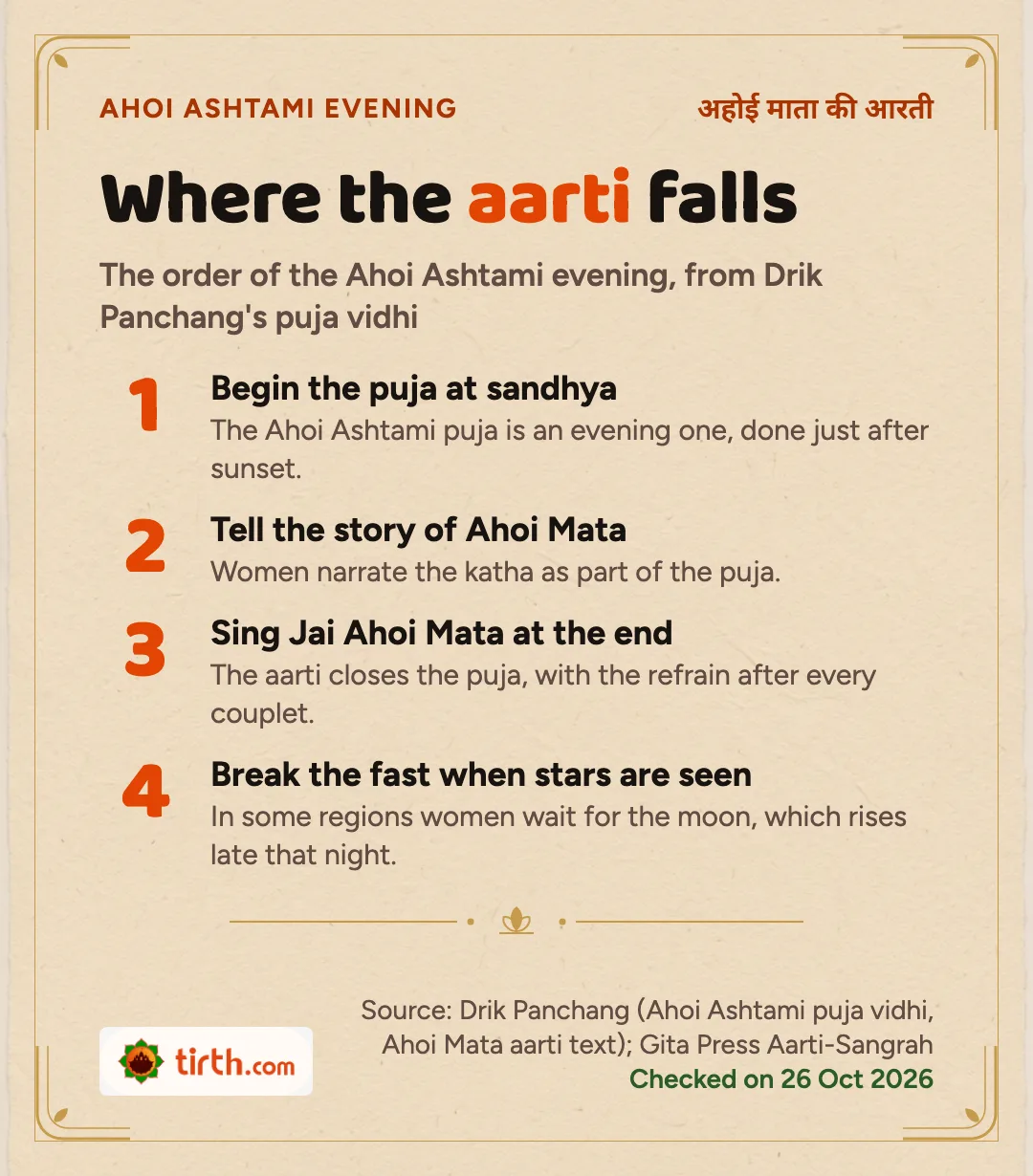
At the very end. The puja itself is an evening one, and Drik Panchang’s puja vidhi sets it at sandhya, just after sunset, on the day women keep the Ahoi Ashtami fast for the well-being and long life of their children.
As part of the puja the women tell the story of Ahoi Mata. A devotee who accidentally killed the young of a sei (a porcupine), and was later blessed with seven sons, is at the centre of most tellings. The katha is on Tirth: the Ahoi Ashtami katha. Then the aarti. Drik Panchang’s vidhi puts the Ahoi Ashtami aarti at the end of the puja, and the Gita Press Aarti-Sangrah gives that same rule for puja in general, saying aarti is done at the end.
The fast ends at twilight when the stars are seen, though in some regions women wait for the moon, which rises late that night.
Any family wanting a pandit to perform a puja for them can book a puja on Tirth.
Frequently asked questions
Who are Kamla, Brahmani and Rudrani in the Ahoi Mata aarti?
Kamla is one of Lakshmi’s names. Brahmani is the consort of Brahma, his shakti. Rudrani is the wife of Rudra (Shiva), and it is also a name of the goddess Durga. Some copies spell Brahmani as Braahmani, which in Platts’ dictionary is a different word altogether, meaning a Brahmin woman.
What are the fourteen jewels in the aarti?
The fourteen jewels are what ratan chaturdash means. According to the Hindi Shabdasagar they are the fourteen treasures thrown up by the churning of the ocean.
Does “na koi putra paata” mean son or child?
Platts allows either. It gives putra as son, and as child. Read the line inside the hymn’s praise of the goddess, where it says that without you no one gains a son. Those are its words about her, not a promise.
What is an aarti, exactly?
Aaratrik and neerajan are other names for it, according to the Gita Press Aarti-Sangrah. It comes at the end of a puja, commonly with a lamp of five wicks. While the lamp is shown, its words praise the deity.
Can the puja be done before a printed picture of Ahoi Mata?
Yes. Families who cannot draw Ahoi Mata on the wall can worship a printed Ahoi Ashtami picture instead, Drik Panchang says. When it is drawn, the image has eight corners (ashta koshthak), and the sei and its young appear beside the goddess.