
Ahoi Ashtami katha: Syahu Mata and the seven sons, in both tellings
Tirth editorial · 11 Feb 2026 · 8 min read
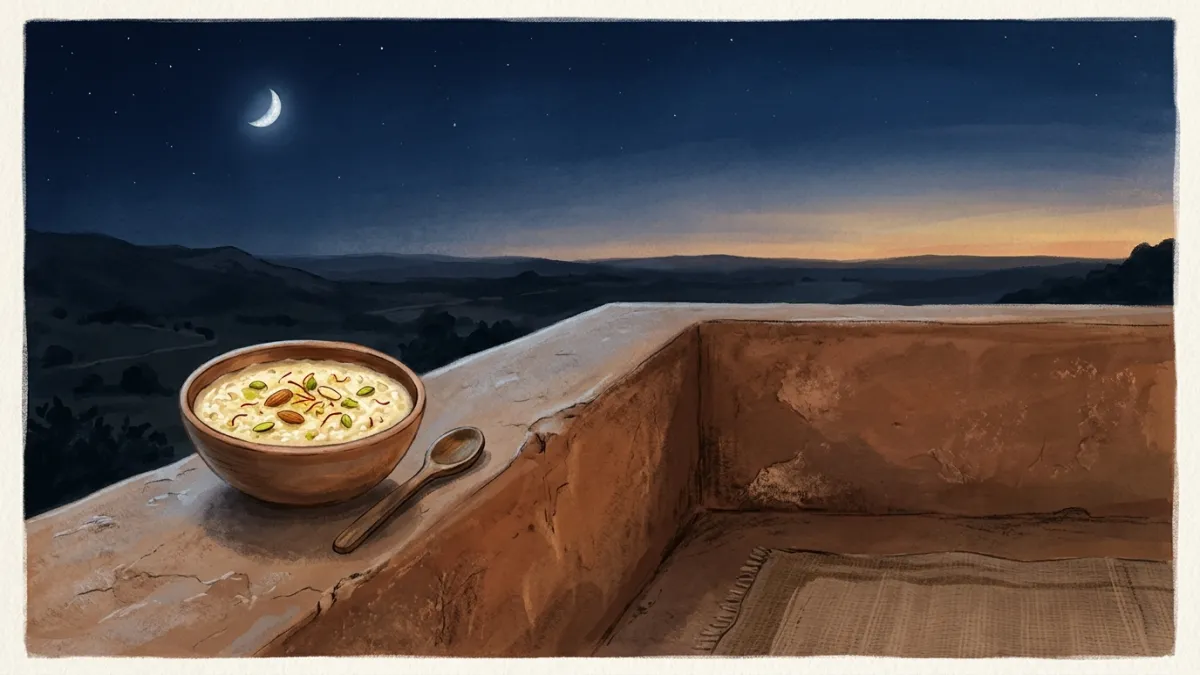
By sunset on Kartik Krishna Ashtami (the eighth day of the waning moon in Kartik), mothers who have fasted for their children since sunrise sit down before Ahoi Mata to hear the Ahoi Ashtami katha. A mother kills a Syahu’s cub without meaning to and loses her own sons. She wins them back by worshipping Ahoi Mata.
Ahoi Ashtami in 2026: Sunday, 1 November. Ashtami tithi: 2:51 PM on 1 November to 1:09 PM on 2 November. Sunset in New Delhi: 5:36 PM. Moonrise in New Delhi: 11:35 PM.
Checked on 24 Oct 2026. Ahoi Ashtami timings for your city
Dates and timings are calculated for New Delhi using the traditional North Indian panchang. Timings change from city to city, sometimes by more than an hour for moonrise; see the Tirth Spiritual Calendar for your location.
There are two ways of telling it. The short one is over in a few breaths. The long one belongs to Hindi-speaking homes, the sahukar (moneylender) katha, and it brings a youngest daughter-in-law into the story along with a cow called Surahi. Both follow in plain English. Events in the order they happen.
The short Ahoi Ashtami katha of the mother of seven sons
A mother of seven sons went to the forest a few days before Diwali to dig soil. She needed it to repair her house.
As she dug, her spade struck the cub of a Syahu, the porcupine, and killed it. By accident.
Within a year all seven of her sons died. An elderly woman, seeing her grief, told her to repent for the cub’s death and to worship Ahoi Mata (in another telling it is the villagers who give her this advice).
So on the Ashtami she drew the face of the cub, kept a fast and prayed to Ahoi Mata. Her sons came back to her.
That is where it ends. If small children are sitting with you at the puja, choose this one to read aloud (the whole story is in it, and it ends before they start fidgeting).
The sahukar’s daughter, the youngest bahu and the Surahi cow
A sahukar’s married daughter had come home to her parents for Diwali. With her seven bhabhis (her brothers’ wives) she went out to dig clay, and while digging she killed a Syahu’s young.
Syahu answered by binding her womb, kokh bandhna as the Hindi tellings put it, so that she would not have children of her own. Of the seven sisters-in-law, only the youngest agreed to take this on in her place.
From then on, every child the youngest bahu (daughter-in-law) gave birth to died within seven days. In her sorrow she was sent to a pandit, who told her to serve the Surahi cow, also called Surabhi. She served the cow, and the cow set out with her across the seven seas to Syahu Mata.
Some tellings add an episode on the way. While they rest, the youngest bahu sees a snake about to bite a Garuda chick and kills the snake. The mother bird returns, sees the blood and at first blames her. Then she learns what really happened, and she helps the bahu on to Syahu Mata.
Syahu Mata was pleased with her service and blessed her with seven sons and seven daughters-in-law.
Small things move about from one telling to another, who goes to the pandit for instance, and even the ending is not fixed, because one telling closes on seven sons and seven daughters-in-law where another has seven sons and a daughter-in-law. What holds steady is the clay, the dead young of the Syahu, the sacrifice the youngest bahu makes, the Surahi cow and the blessing from Syahu Mata. Go with the version your family already tells.
The words of the Ahoi Mata aarti, for families who sing one at this puja, are on a page of their own.
Who is Ahoi Mata, and which animal is Syahu?
The fast is kept for Ahoi Mata, and the evening prayers go to her. In her, people see a form of Maa Parvati, and they look to her as the one who protects children.
Syahu is a porcupine. Sahi or Sehi, in some spellings. Women draw her with her young beside Ahoi Mata or set up a picture of them, and the Syahu picture is worshipped too. Some English retellings call the animal a hedgehog. Online you will also find a jackal (siyarni) in the story, or a lion cub, though none of the published tellings backs either one.
We would much rather the animal is told right. The Syahu on the wall next to Ahoi Mata is the same one whose young die in the katha, so if a jackal or a lion slips into the story, the family ends up hearing about one animal while looking at another.
Which scripture is the Ahoi katha from?
Look for a Purana behind it and the published tellings will not give you one, or any other scripture. North India, where the day is most widely kept, is where this folk vrat katha (the story told with a fast) comes from, and the women who tell it each and every year are the ones who pass it on. The day has a homely name too. Ahoi Aathe, as many families call it.
Its tithi is Krishna Paksha Ashtami, Krishna Paksha being the waning fortnight. North India follows the purnimanta calendar, in which a month ends on the full moon, and there the day falls in Kartik, while the amanta calendar ends its months on the new moon and so puts this very day in Ashwin. Same day. Only the name of the month is different.
Since the Kartika Mahatmya praises the month of Kartik, you might expect the story to come from there. No published telling says it does. Mothers and grandmothers carry it from year to year, or rather they carry their own version of it, which is why the small details move about between families.
When is the katha told on Ahoi Ashtami day?
Only the bare outline of the day goes here, enough to show where the katha sits (the full puja vidhi is for the festival page).
- Take the sankalp first thing in the morning. It is a short vow that you will keep the fast for your children.
- Fast the way the women of your family fast. The customary fast is nirjala, with nothing to eat or drink from sunrise.
- On the wall, draw Ahoi Mata (or put up a picture of her) and keep Syahu with her young at her side.
- Once the sun has set, sit down for the puja. This is when someone reads or tells the katha, with the family listening.
- Break your fast when you see the first stars come out. Moonrise comes late on this night, and some women hold out for it instead.
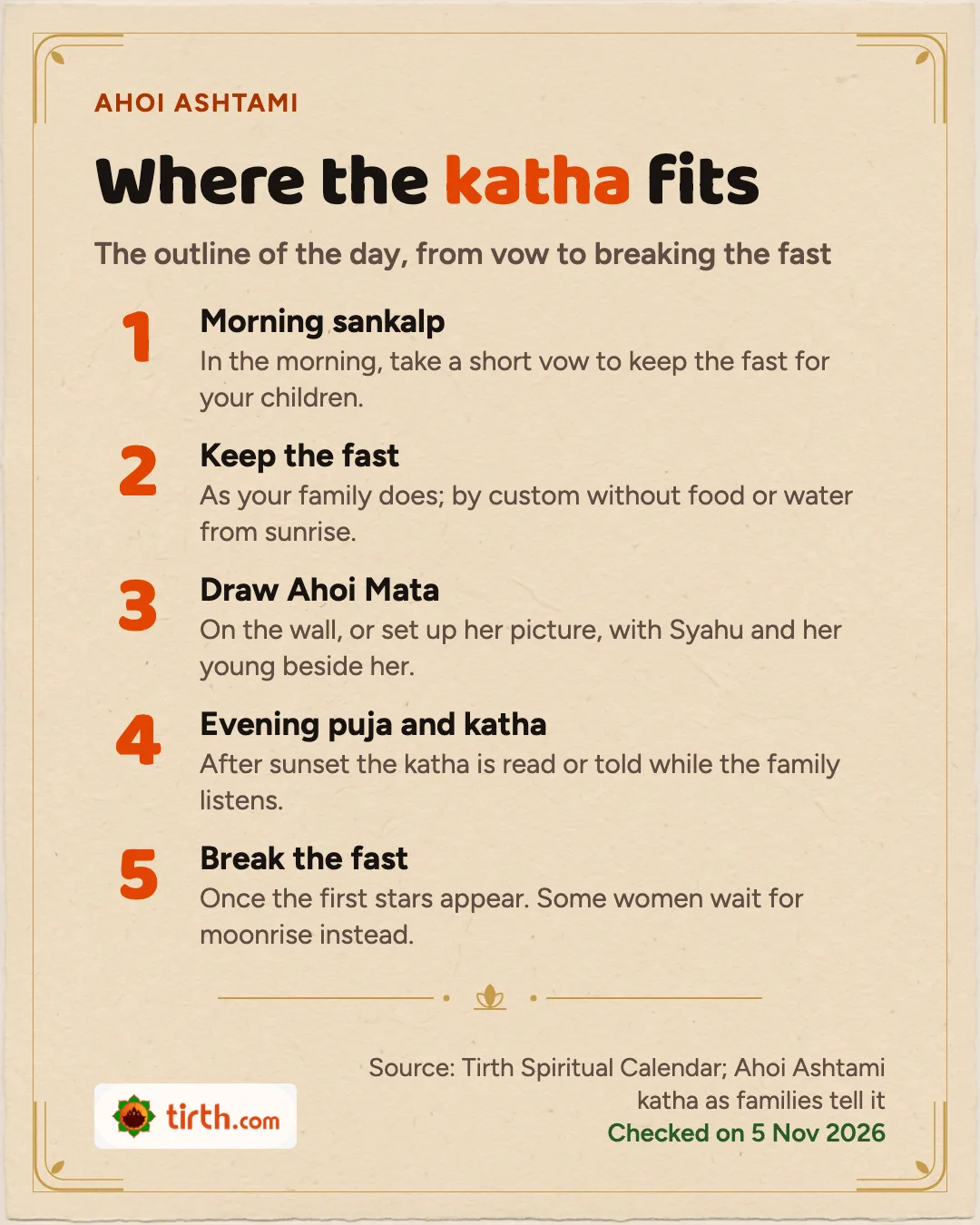
Moonrise is not the same in every city, and the Ahoi Ashtami page in the Spiritual Calendar has yours.
How far is Ahoi Ashtami from Karwa Chauth and Diwali?
Karwa Chauth comes first, Ahoi Ashtami a few days later, and Diwali approximately a week after that. Do not count days from one to the next (the gap moves by a day or so each year), and let the calendar give you the dates instead. The Karwa Chauth katha is a separate story, told on its own day.
Mothers keep other fasts for their children as well, and the Jivitputrika vrat katha and the Hala Shashthi vrat katha belong to two of them.
At Govardhan in Mathura district, the night of Ahoi Ashtami brings Radha Kund Snan too, a bath in Radha Kund that begins at midnight. Couples who hope for a child take it as a matter of faith.
The Tirth vrat calendar lists every fast coming up.
Frequently asked questions
What is the story of Ahoi Ashtami?
Digging soil before Diwali, a mother kills a Syahu’s (porcupine’s) cub by accident, and then she loses her seven sons. An elderly woman tells her to repent. So on the Ashtami, with the cub’s face drawn, she fasts for Ahoi Mata, and her sons come back to her. In the longer telling it is a sahukar’s youngest daughter-in-law who carries the story, with help from the Surahi cow, until Syahu Mata blesses her.
What is Syahu (Sehi) in Ahoi puja?
The porcupine of the katha, the one whose young are killed, is Syahu (also called Sahi or Sehi). She and her young are drawn or set up beside Ahoi Mata, and women worship that picture with the goddess.
Can the Ahoi fast be broken after moonrise?
Some women do wait for moonrise, which comes late on Ahoi Ashtami night. Breaking the fast at the first stars after sunset is the usual custom, though, and in the end you go by whatever the women of your family have always done.
Who reads the Ahoi katha, and when?
At the evening puja, once the sun has set. Whether it is read out or told, and by whom, is something each family settles by its own custom.
Is the Ahoi katha in any Purana?
Not in any telling that has been published. They give no Purana and no other scripture as the source, and since this is a North Indian folk vrat katha, its wording changes between families and between regions.
Is Ahoi Ashtami only for sons?
Nothing in the katha or the puja asks you to leave out a daughter. The fast is described as a mother’s fast for her children, and Ahoi Mata is regarded as a protector of children. As for the seven sons in both kathas, the old stories were simply told that way.
Continue on Tirth
- Tirth Spiritual Calendar: Ahoi Ashtami, tithi, sunset and moonrise by city.