
Agni Mantra: The Vedic Mantras to Agni with Meaning
Tirth editorial · 12 Jan 2026 · 6 min read
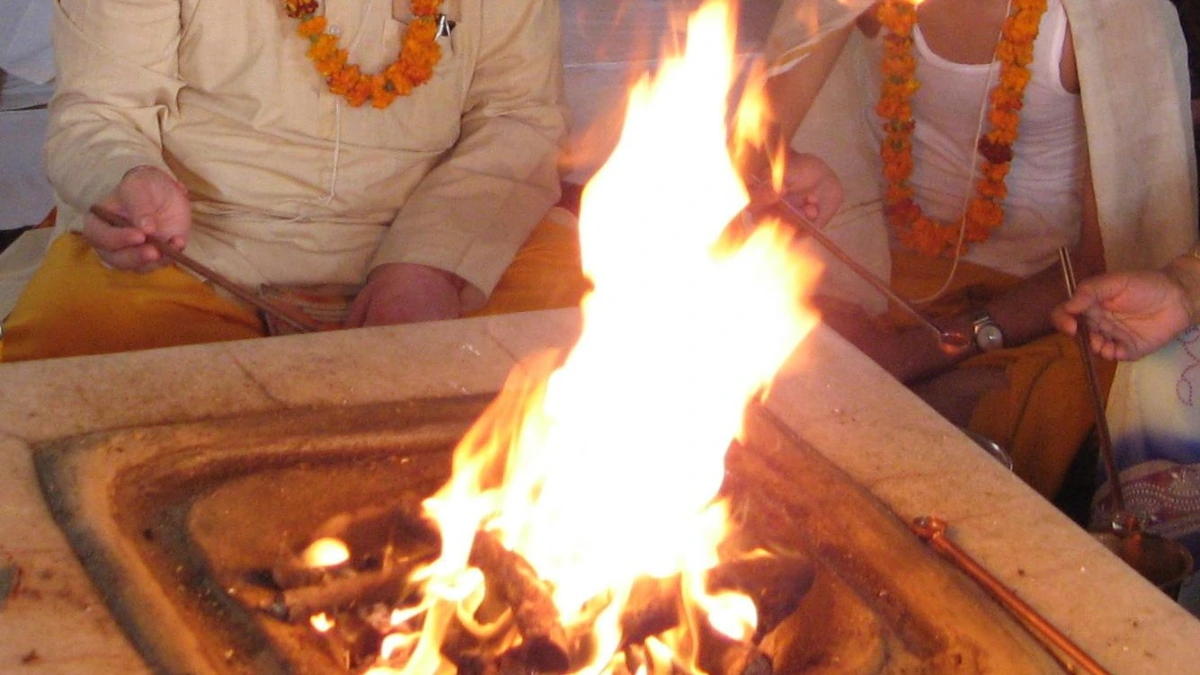
Which Agni mantra do people mean when they ask for it by name? The name usually refers to the first verse of the Rigveda, Agnim ile purohitam, which praises Lord Agni as the priest of the sacrifice, and after it the short words Agnaye svaha said as an offering goes into the havan fire.
The verse is taken from a printed edition of the Rigveda, and the svaha formula from Buhler’s printed translation of the Apastamba Dharma Sutra.
Agnim ile purohitam, the opening verse of the Rigveda
Hymn 1.1 of the Rigveda has nine verses, all to Agni, and Griffith’s headnote ascribes it to the seer Madhuchchhandas Vaishvamitra, a descendant of Vishvamitra. Verse 1 is the one this page is about.
| Devanagari | Transliteration |
|---|---|
| अग्निमीळे पुरोहितं यज्ञस्य देवमृत्विजम् । होतारं रत्नधातमम् ॥ | agnim ile purohitam yajnasya devam ritvijam, hotaram ratnadhatamam. |
| With the Vedic accents marked | agním īḷe puróhitaṃ yajñásya devám ṛtvíjam | hótāraṃ ratnadhā́tamam. |
Ralph Griffith’s 1896 translation puts it in English as “I laud Agni, the chosen Priest, God, minister of sacrifice, The hotar, lavishest of wealth.” The Sanskrit above follows Max Muller’s printed edition of the Rigveda with Sayana’s commentary (1849), and Sanskrit Wikisource gives the same words, accents included.
What purohitam, ritvijam and hotaram tell you about Agni
Three of the eight words have a note of their own in Griffith’s edition, and they are the three priest words. The other five appear here only as he translates them in the verse.
| Word | Griffith (1896), note or translation |
|---|---|
| agnim | No note or rendering of his own. The word is simply the accusative of Agni |
| ile | “I laud” (translation) |
| purohitam | “chosen priest”, from the sense of one placed in front, like the Latin praepositus (note) |
| yajnasya | “of sacrifice” (translation) |
| devam | “God” (translation) |
| ritvijam | a priest who sacrifices at the proper seasons (note) |
| hotaram | an invoking priest who calls the gods to the offering, “the hotar” in the translation (note) |
| ratnadhatamam | “lavishest of wealth” (translation) |
Griffith explains the three priest words in one note.
It says Agni is the messenger and mediator between earth and heaven, the one who announces the hymns to the gods and carries the worshippers’ oblations to them, and because he gathers up the work of the human priests in himself he is called purohita, ritvij and hotar at once.
Put in plain words, the verse says this. I praise Agni, the priest set at the front of the rite, the god who serves the sacrifice at its proper time, the one who calls the gods to come, the most generous giver of wealth.
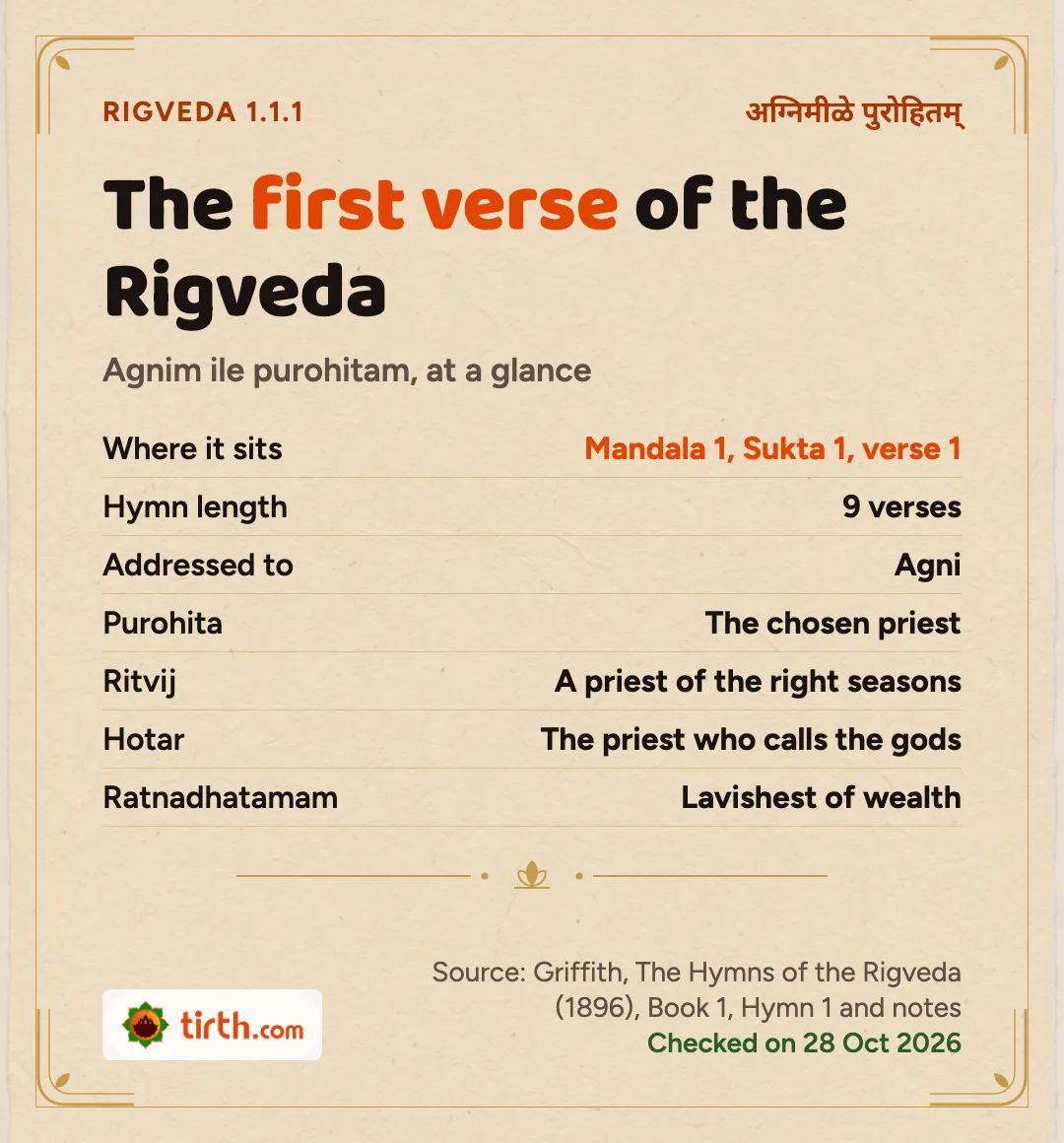
If you learn only one Agni mantra, we would ask you to learn this one, with the table above. The verse is sourced to a printed edition. The three priest words carry notes in Griffith’s.
What does Agnaye svaha mean at a havan?
These are words said at a havan as each offering goes into the fire, and they are not a verse at all. Agnaye svaha means “to Agni, svaha”. Buhler’s note to the Apastamba Dharma Sutra (Sacred Books of the East, vol. 2) lists it in exactly that form, “Agnaye svaha, to Agni svaha”, as the first of the Taittiriya Aranyaka formulas it lists, since offering formulas put the deity’s name in the “to” form and add svaha.
| Line | Meaning | When it is said |
|---|---|---|
| Agnaye svaha | To Agni, svaha | As the offering is made |
Dictionary entries describe svaha as an exclamation uttered when making an offering to the gods, and agnaye svaha is among the examples they give.
A word on a line that often gets listed next to it, Bhupataye svaha, Bhuvanapataye svaha, Bhutanam pataye svaha. In the Taittiriya Samhita, in the sixth prashna of its second kanda, these three are said when an oblation has spilled, to the lords of the earth, of the atmosphere and of beings. They repair a slip in the rite. So this page does not count them as an Agni mantra. Nor are they a mantra for before meals.
Vaishvanaraya vidmahe, the Agni Gayatri with a book behind it
The Agni Gayatri that can be traced to a text is in the Mahanarayana Upanishad, which forms chapter 10 of the Taittiriya Aranyaka.
| Transliteration | Meaning (Swami Vimalananda’s translation) |
|---|---|
| Vaishvanaraya vidmahe, Lalilaya dhimahi, tanno Agnih prachodayat | May we know Vaishvanara; may we meditate upon Lalila; may Agni impel us towards it |
That English is Swami Vimalananda’s, in the translation published by the Sri Ramakrishna Math, where the verse carries his number I-32. Devotional sites print other Agni Gayatri wordings as well, one of them beginning Jatavedase vidmahe. We have not found those in a printed text. So they are left out.
The seven tongues of fire in Mundaka Upanishad 1.2.4
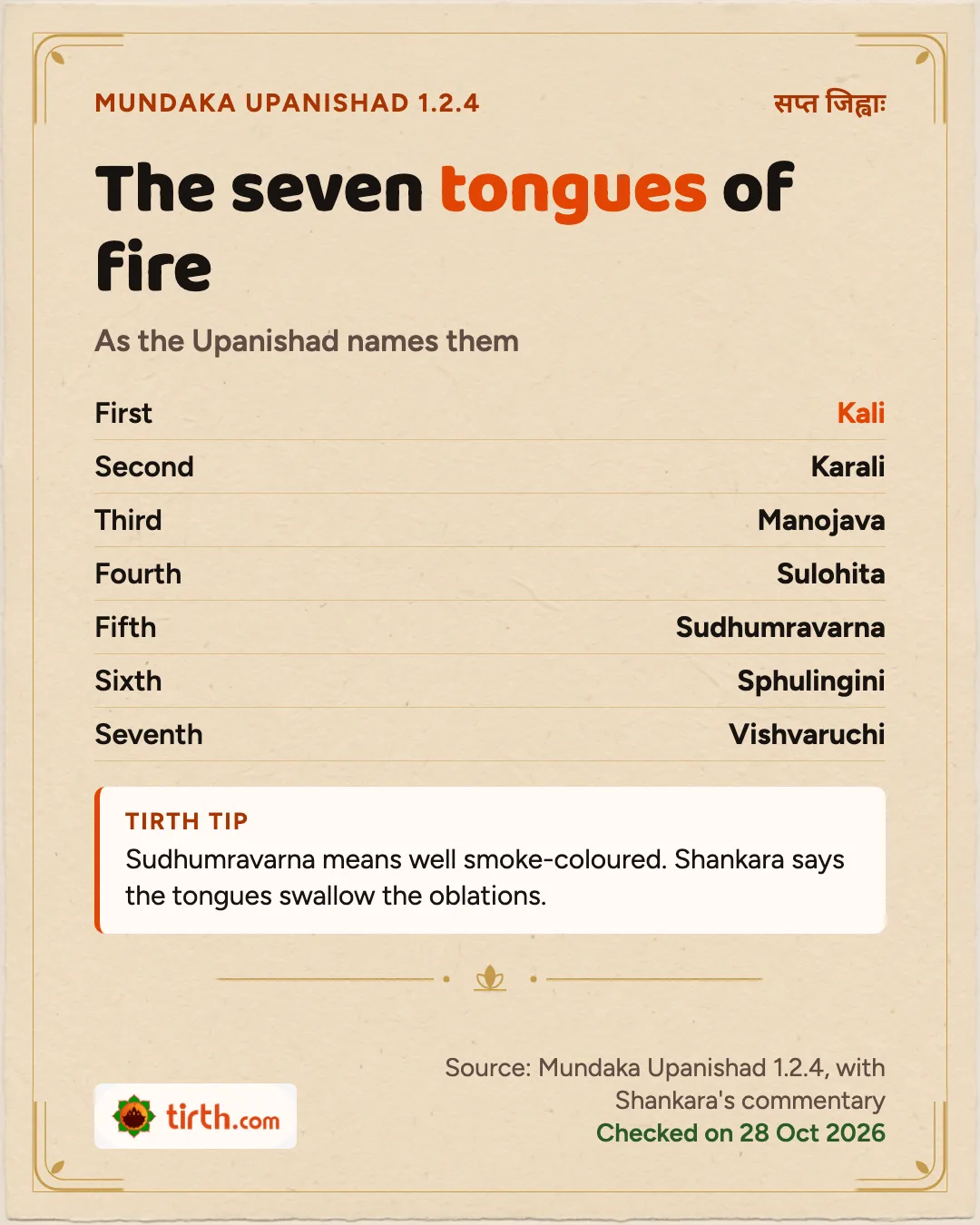
The Mundaka Upanishad, at 1.2.4, names the seven tongues of fire as Kali, Karali, Manojava, Sulohita, Sudhumravarna, Sphulingini and Vishvaruchi. Shankara, in his commentary, says these tongues swallow the oblations. The fifth is Sudhumravarna, “well smoke-coloured”, and translators word the colours a little differently.
More on Agni himself is on the Lord Agni page.
Is there a set way to say an Agni mantra at home?
The texts quoted on this page, from the Rigveda to the Mundaka Upanishad, lay down no home routine for saying an Agni mantra.
The Rigveda verse itself asks for nothing and simply praises him as the hotar who brings the gods to the offering.
A priest can do it for you. You can book a havan or puja on Tirth.
Other mantras on Tirth include the Gayatri Mantra, theMaha Mrityunjay Mantra, the Surya mantra, the Rudra mantra and the Brahma mantra.
Frequently asked questions
What is the Agni mantra?
Usually it means Agnim ile purohitam, the first verse of the Rigveda, which praises Agni as the priest of the sacrifice. People also use the name for Agnaye svaha, the words said at each offering in a havan.
Which verse opens the Rigveda?
Rigveda 1.1.1, agnim ile purohitam yajnasya devam ritvijam, hotaram ratnadhatamam. It is the first of the nine verses of hymn 1.1, all addressed to Agni.
What does Agnimile purohitam mean?
Griffith translates the verse as “I laud Agni, the chosen Priest, God, minister of sacrifice, The hotar, lavishest of wealth.” Purohita, in his note, is the chosen priest, one placed in front.
What is the Agni Gayatri mantra?
The form found in the Mahanarayana Upanishad is Vaishvanaraya vidmahe, Lalilaya dhimahi, tanno Agnih prachodayat. Swami Vimalananda translates it as “May we know Vaishvanara; may we meditate upon Lalila; may Agni impel us towards it.”
What does Agnaye svaha mean?
Agnaye svaha is “to Agni, svaha”. That is the form Buhler’s Apastamba Dharma Sutra note gives. Dictionaries describe svaha as an exclamation uttered when making an offering to the gods.
What are the seven tongues of Agni?
The Mundaka Upanishad (1.2.4) names them Kali, Karali, Manojava, Sulohita, Sudhumravarna, Sphulingini and Vishvaruchi. Shankara’s commentary says they swallow the oblations.