
Om Jai Gange Mata: Ganga Aarti Lyrics with Meaning
Tirth editorial · 7 Jan 2026 · 10 min read
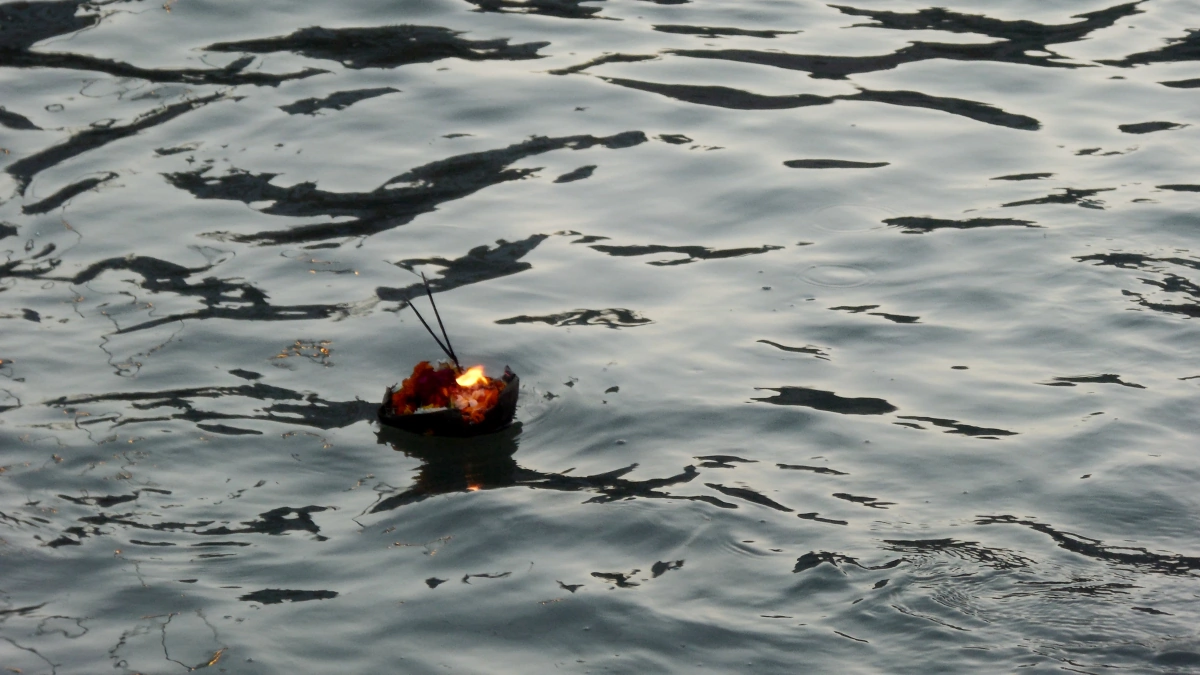
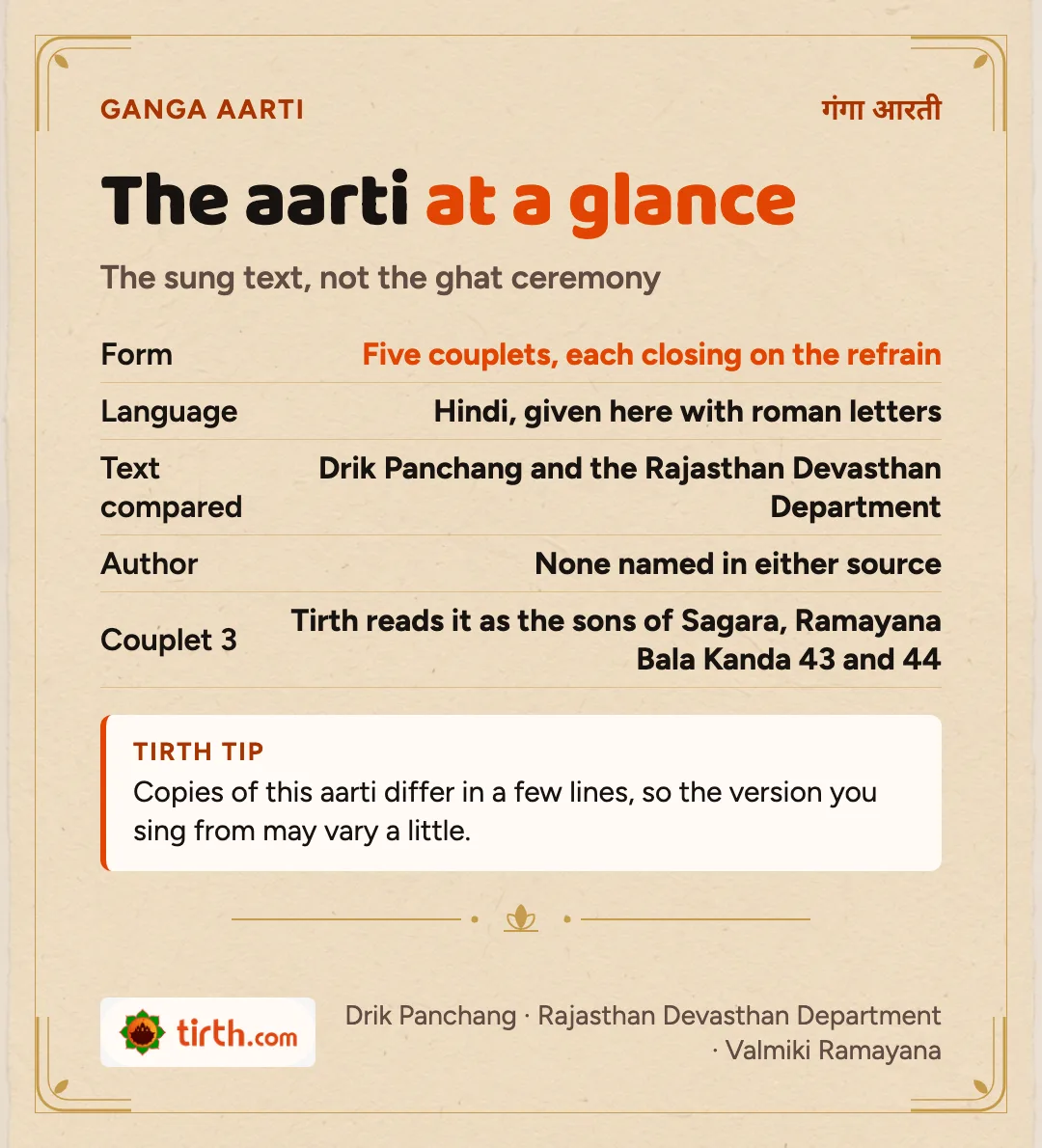
The Ganga aarti, Om Jai Gange Mata, is a Hindi aarti of five couplets sung to Maa Ganga. Tirth reads its third couplet as a Ramayana episode: “Putra Sagar ke taare” means you saved the sons of Sagara, and Tirth links that line to the sixty thousand whose release Brahma announces in Bala Kanda 44 of the Valmiki Ramayana.
The full text is here in Hindi and in roman letters, with a plain meaning of each couplet, the dictionary behind each word and the story behind that third couplet.
Who the Ganga aarti speaks to, and who wrote it
It speaks to Ganga as a mother. Every couplet closes on the same call, “Om jai Gange Mata”, and the very first line adds maiya, a fond word for mother.
Nobody is named as its poet. Neither Drik Panchang nor the Aarti Collection of the Government of Rajasthan’s Devasthan Department gives an author or a date of composition, so this page gives none either.
The evening Ganga aarti on the ghats is a separate subject, a ceremony with its own places and hours, and the Maa Ganga page and the city pages for Haridwar and Varanasi, or the wider Tirth destinations list, are where that belongs.
Om Jai Gange Mata in Hindi and roman letters, couplet by couplet
Sing the refrain after every couplet.
| Couplet | Hindi | Roman letters | Meaning (Tirth’s rendering) |
|---|---|---|---|
| 1 and refrain | ॐ जय गंगे माता, मैया जय गंगे माता। जो नर तुमको ध्याता, मनवांछित फल पाता॥ ॐ जय गंगे माता॥ | Om jai Gange Mata, maiya jai Gange Mata. Jo nar tumko dhyata, manvanchhit phal pata. Om jai Gange Mata. | Victory to you, Mother Ganga. Whoever meditates on you gains the fruit their heart wished for. |
| 2 | चन्द्र-सी ज्योति तुम्हारी, जल निर्मल आता। शरण पड़े जो तेरी, सो नर तर जाता॥ | Chandra-si jyoti tumhari, jal nirmal aata. Sharan pade jo teri, so nar tar jata. | Your light is like the moon’s and your water comes pure. Whoever takes refuge in you crosses over, which is to say is saved. |
| 3 | पुत्र सगर के तारे, सब जग को ज्ञाता। कृपा दृष्टि हो तुम्हारी, त्रिभुवन सुख दाता॥ | Putra Sagar ke taare, sab jag ko gyata. Kripa drishti ho tumhari, tribhuvan sukh data. | You saved the sons of Sagara, as the whole world knows. Let your gracious glance fall on us, giver of happiness to the three worlds. |
| 4 | एक बार जो प्राणी, शरण तेरी आता। यम की त्रास मिटाकर, परमगति पाता॥ | Ek baar jo prani, sharan teri aata. Yam ki traas mitakar, paramgati pata. | The living being who comes to your refuge even once is freed from the dread of Yama and reaches the highest state. |
| 5 | आरती मातु तुम्हारी, जो नर नित गाता। सेवक वही सहज में, मुक्ति को पाता॥ | Aarti matu tumhari, jo nar nit gata. Sevak wahi sahaj mein, mukti ko pata. | Whoever sings your aarti every day, Mother, that servant of yours gains mukti (liberation) with ease. |
An older copy of this page ended with a sixth stanza that repeated the opening couplet with “Shri Gange Mata” in place of “maiya”. Neither published version prints that repeat, so it is left out of the table.
The meanings are Tirth’s own wording.
What do dhyata, taare and paramgati mean in the Ganga aarti?
Two dictionaries sit behind this table. One is Platts, A Dictionary of Urdu, Classical Hindi and English, and the other is Monier-Williams’s Sanskrit-English Dictionary, used where Platts has no entry for the sense the aarti needs (jyoti is one such word, since Platts gives jot only in another sense). Page numbers are from the online editions linked under Sources.
| Word | Dictionary meaning | Dictionary | Sense in the aarti (Tirth’s rendering) |
|---|---|---|---|
| ध्याता (dhyata) | dhyān, meditation, contemplation, mental representation of the divinity worshipped (verb ध्यावना, to meditate on) | Platts, p. 553 | one who meditates on you |
| मनवांछित (manvanchhit) | vāñchā, wish, desire, longing | Monier-Williams, p. 939 | wished for in the heart |
| फल (phal) | fruit, result, consequence, reward | Platts, p. 288 | |
| नर (nar) | a man, a person, mankind | Platts, p. 1128 | |
| माता, मातु (mata, matu) | mother, a respectful address to a woman. Matu is the rustic or dialect form | Platts, pp. 977 and 978 | |
| मैया (maiya) | no dictionary entry found | none | an affectionate word for mother |
| चन्द्र (chandra) | the moon, also glittering, shining | Monier-Williams, p. 386 | |
| ज्योति (jyoti) | light, brightness (of sun, fire, sky) | Monier-Williams, p. 427 | |
| निर्मल (nirmal) | spotless, clean, pure, shining, bright | Monier-Williams, p. 541 | |
| शरण (sharan) | protection, shelter, refuge, a place of refuge | Platts, p. 726 | |
| तर, तरना (tarna) | to cross over, pass over, to be saved | Platts, p. 320 | |
| तारे, तारना (taarna) | to enable to cross, to deliver, save, to absolve from sin, to free from further transmigration | Platts, p. 305 | |
| पुत्र (putra) | son, child | Platts, p. 224 | |
| सगर (Sagara) | a king of the solar race, sovereign of Ayodhya | Platts, p. 667 | |
| जग (jag) | the world, earth, universe | Platts, p. 383 | |
| ज्ञाता (gyata) | knowing, wise, one who knows, a knower | Platts, p. 390 | known to (all the world), the usual reading of the line |
| कृपा (kripa) | pity, tenderness, compassion, grace | Monier-Williams, p. 305 | with दृष्टि, a gracious glance |
| दृष्टि (drishti) | seeing, sight, vision, look | Platts, p. 512 | with कृपा, a gracious glance |
| त्रिभुवन (tribhuvan) | the three worlds (heaven, earth, the lower regions), the universe | Platts, p. 316 | |
| सुख, दाता (sukh, data) | happiness, comfort, ease, and giver, bestower, benefactor | Platts, pp. 666 and 499 | |
| प्राणी (prani) | a living or sentient being, one who breathes | Platts, p. 237 | |
| यम (Yam) | Yama, the regent of the infernal regions (god of death), also restraint, self-control | Platts, p. 1252 | |
| त्रास (traas) | alarm, fear, dread, terror | Platts, p. 315 | |
| परमगति (paramgati) | param, highest, supreme, and gati, going, way, course, refuge, state | Platts, p. 253, and Monier-Williams, p. 347 | the highest course or state |
| आरती (aarti) | a ceremony of adoration in which a platter with a lit lamp (often five wicks), flour and incense is moved in circles before the deity, also a hymn of praise | Platts, p. 39 | |
| नित (nit) | always, daily, constantly, from Sanskrit nitya | Platts, p. 1122 | |
| गाता, गाना (gana) | to sing, chant, celebrate, to sing the praises of | Platts, p. 893 | |
| सेवक (sevak) | servant, attendant, a worshipper, a votary, a follower | Platts, p. 715 | |
| सहज (sahaj) | innate, natural, with natural ease | Platts, p. 706 | |
| मुक्ति (mukti) | release, deliverance, liberation, final liberation of the soul from further transmigration | Platts, p. 1058 |
Gyata needs a word of warning. Platts gives knower, one who knows, yet “sab jag ko gyata” is usually sung and understood as “known to the whole world”, and the meaning table above follows that usual sense, which is Tirth’s reading and not something the dictionary says.
For dhyata, Platts gives dhyān and the verb ध्यावना, to meditate on, and “one who meditates on you” in the table is Tirth’s reading of that verb.
Maiya, the word everyone sings, has no entry in either dictionary consulted here, so its gloss stands on plain usage alone.
Who are the sons of Sagara in the Ganga aarti?
They are the sixty thousand sons of King Sagara (Sagar in the sung line), and their story is told in the Bala Kanda of the Valmiki Ramayana, sargas 43 and 44.
In sarga 43, Bhagiratha’s penance wins Lord Shiva’s agreement to receive Ganga on his head, and once she is released she follows Bhagiratha’s chariot down to the netherworld, where the ashes of his ancestors lie, until her waters flood the mound of ashes. Then Brahma speaks. In sarga 44 he tells Bhagiratha that the sons of Sagara are freed and reach heaven, that they will abide there for as long as the ocean’s waters remain on earth, and that Ganga will be Bhagiratha’s daughter.
The aarti itself never names the Ramayana.
Reading couplet 3 as this episode is Tirth’s reading, resting on the shared name and on taarna, which Platts gives as to deliver, to save. One suggestion from us: before singing it with children, tell them the two sargas first, as a story. The Shri Ramayana ji aarti is another aarti that sings of the Ramayana.
Can you sing Om Jai Gange Mata at home, with a lamp?
Yes. Platts describes aarti as a ceremony of adoration in which a platter with a lit lamp, often of five wicks, together with flour and incense, is moved in circles before the deity, and as a hymn of praise as well. The Ganga aarti is the hymn half of that.
If you are leading it for a parent who knows the tune but has lost some of the words, keep the roman letters open on a phone beside the plate and let them hold the lamp.
The fifth couplet says that whoever sings it every day gains mukti with ease. That is the aarti’s own claim about itself, and this page repeats it without adding to it.
Other aartis with their text and meaning on Tirth are the Narmada Maa aarti, the Saraswati aarti, Om Jai Jagdish Hare and the Ganesh aarti.
Which version of the Ganga aarti is printed here?
The wording follows two published versions that agree with each other line for line, the Shri Ganga ji ki aarti in the Aarti Collection of the Rajasthan Devasthan Department and the Aarti Shri Gangaji page on Drik Panchang.
Two book listings, on Goodreads and Pustak.org, describe the Gita Press, Gorakhpur, Hindi collection Sachitra Aarti Sangrah as including a Shri Gangaji aarti. The wording on this page was not compared with that printed book; it is taken from the two versions above.
An older copy of this very page differed from both published versions in couplets 4 and 5. It had “ek baar hi jo teri, sharanagati aata” in couplet 4 and “jo jaan nitya jata” and “das wahi” in couplet 5, along with the misspelt “man vanshit” in couplet 1. If you are writing the aarti into a family notebook, copy couplets 4 and 5 from the table above, which follows the two published versions.
Text checked on 28 October 2026 against Drik Panchang and the Rajasthan Devasthan Department’s Aarti Collection.
For Maa Ganga herself, her forms and her places, the Maa Ganga page on Tirth is the place to go next, and families who would like a priest to perform a puja for them can see the pujas Tirth arranges.
Frequently asked questions
What is Om Jai Gange Mata?
It is the Ganga aarti, a Hindi aarti of five couplets to Maa Ganga, each followed by the refrain “Om jai Gange Mata”. Drik Panchang heads it Aarti Shri Gangaji and the Rajasthan Devasthan Department heads it Shri Ganga ji ki aarti.
Who wrote the Ganga aarti?
None is given. Neither published version compared for this page names an author or a date of composition, so a composer named elsewhere online needs a printed source behind it before anyone should rely on the name.
Is this the same as the Ganga aarti at the ghats?
This page is the sung text of Om Jai Gange Mata. The evening ceremony at the ghats is its own subject, with its own places and hours, and the Maa Ganga page and Tirth’s destination pages cover it.
Who are the sons of Sagara mentioned in the aarti?
The sixty thousand sons of King Sagara. In the Valmiki Ramayana, Bala Kanda sargas 43 and 44, Ganga’s waters flood their ashes and Brahma tells Bhagiratha they are freed and reach heaven. Linking the aarti’s line to this episode is Tirth’s reading.
What does paramgati mean?
Param is highest or supreme and gati is a course, a way or a state, so paramgati is the highest course or state. Couplet 4 says the one who comes to Ganga’s refuge even once reaches it.
Can I sing the Ganga aarti at home?
Yes. Aarti is both the lamp offering and a hymn of praise, and the five couplets are the hymn half of it.